11 October 2011
With the recent flooding situation in Thailand (Link), the price of rice is going to increase. This is only the beginning of a multi-decade long increase in the price of food as climate change, peak oil and a growing population make it increasingly difficult to feed everyone satisfactorily (850 million people are chronically hungry according to FAO). Mr Lee KY thinks that it is no problem because we can pay for it if our economic growth is strong.
Lee Kuan Yew in TODAYONLINE:
Student: In the next 20 to 30 years time, what if global demand for food outstrips supply, then what will be of our food security plan?It does not matter whether you grow your own food or you buy your food. The question is the price? Really, Mr. Lee? Let's go back a few years in history and consider the following news headlines from 2008:
Mr Lee: It doesn't matter whether you grow your own food or you buy your food. The question is the price. If there is a food shortage worldwide, the price of food, produce will go up. And the answer for a country like Singapore is to make sure that our incomes rise, our total GDP rises faster than the food prices.
Brazil May Curb Rice Exports to Boost Inventory
Vietnam to cut rice exports to curb inflation
Cambodia Halts Rice Exports to Curb Rising Domestic Prices
India introduces rice export ban
And also from 2011
Myanmar Puts Lid on Its Rice Exports
Egypt says rice export ban to Oct 2011
It is often said that money makes the world go round, but when times are desperate and push comes to shove, governments around the world are going to restrict their food exports to protect their domestic supplies and to calm any local food unrest. When that happens, it does not matter how rich you are because no country is going to sell any food to you. Your dollars and cents will just be worthless pieces of paper or electronic entries in a bank's vault or computer database.
It was fortunate that Thailand did not ban any rice exports in 2008:
Thailand will not ban rice exports (2008)
With the recent catastrophic floods in Thailand and Vietnam (AFP Link), there is a huge chance that their governments might just introduce curbs or restrictions on the amount of rice that they export.
Now consider this plausible scenario a few years from now: 1. Extreme weather patterns destroy the production of all the major rice exporting nations; 2. Oil production in the Middle East plummets due to Peak Oil and political unrest. Results? Food prices soar and every major food exporting nation bans food exports completely to protect their domestic markets. What becomes of Singapore's food supply? Are you going to chew your paper Singapore dollars? In light of this, is it not important to grow your own food, Mr Lee?
Also, some intelligent responses from a reader in that TODAYONLINE report:
What was wrong with Lee Kuan Yew's reasoning? His typical, mainstream economic way of counting everything in dollars and cents and his strong belief in the free market system. Some comments that I left on Gerald Giam's blog are worth repeating here:davidUpdated 05:42 PM September 06, 2011
When there is global food shortage, it is no longer a matter of price. We may not be able to get any food, or enough food, at any price.
Even if Singapore owns the farm overseas, the foreign government (where the farm is located) may not allow the farm produce to be exported. Even if the foreign government allows the farm produce to be sold to Singapore, the workers at the farms or trucking firms or dockyards may sieze the produce to feed their own families first. Do you think they care about Singapore's survival or the rule of law?
It may not be sexy or wonderful for our economic numbers to produce our own food, but it is time that Singapore placed more importance to food security.
The way I see it, the main problem is that mainstream economists have a wrong set of units for accounting. They reduce everything to dollars and cents which are nothing more than abstractions divorced from the material world. Oil prices hit a low in 1999 at $17/barrel but the price did not tell us what was left in the ground for us to extract. All it did was to create the temporary illusion that oil was plentiful, and that alternative sources of energy were therefore uneconomic and unnecessary – in dollar terms – according to the self-deluded economists.Had they learned to calculate the economic inputs/outputs of a nation in terms of energetic units (Watts, BTUs, etc.), biocapacity and ecological footprint, they would have realized that our entire growth-centric-consumerist economic paradigm is one giant energy sink and resource blackhole that is squandering away at unsustainable rates the earth’s natural capital and natural resources that have taken eons to form.
13 May 2009
It is not unthinkable that we may soon say goodbye to the era of 1500 mile Thai rice, 3000 mile Australian lamb loin chops, 4000 mile New Zealand strip loins, 9000 mile Namibian seafood, and 10,000 mile Norwegian Salmon Fillet in Cold Storage and NTUC Fairprice. Why? Because triple-digit oil prices are going to drive up transportation costs to such an extent that it will be more sensible and affordable to grow our own food. Distance is going to matter again and globalization - the economic integration of nations through unrestricted flow of goods and services - will be reversed with the end of cheap oil.
What will we eat? Our food security is at stake and what is the Agri-Food & Veterinary Authority of Singapore (AVA) doing about it? Their key strategy is to diversify by sourcing from countries as far away as Namibia and Chile. Will this work? No because it still depends on oil for transportation and food producing nations will move to curb exports as we witnessed in 2008 when high food prices forced governments to take action to quell local anxieties; therefore, it is important to substantially increase local food production to guarantee uninterrupted food supplies. Regrettably, AVA is not pursuing the self sufficient route.
Jeff Rubin, chief economist at CIBC World Markets, has written a timely book about peak oil and the end of globalization. It deserves our attention because Singapore's economy is so dependent on trade that we are highly vulnerable to oil shocks. Unlike the 1970s, the next oil shock will be permanent without any recovery in sight - a permanent recession caused by a relentless decline in global oil production. What is worrying is that the Singapore government does not appear to have any detailed contingency plans for peak oil. My email queries to government ministries have only elicited standard template replies like the following:
From: Ministry of Trade and IndustryMany Singaporeans will be in for a rude shock, which will be compounded by the current absence or lack of coverage of these issues by the local media, when they realise how long lasting this crisis will be.
With no indigenous energy resources of our own, we are price-takers and dependent on global markets for our energy resources. Thus, an essential part of our energy security strategy is to diversify our sources of supply, and in the long run, to diversify our fuel types. We have decided to pursue the import of LNG from 2012. We are test-bedding new and renewable energy technologies, and are keeping a watching brief on emerging energy technologies that may become viable for Singapore in the long run.
We would like to thank you for your constructive feedback.
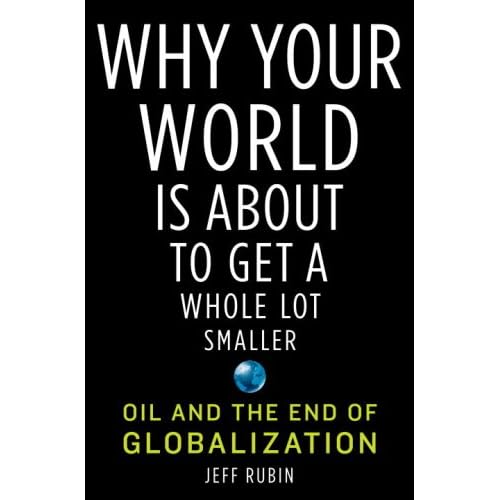
Why Your World Is About to Get a Whole Lot Smaller: Oil and the End of Globalization by Jeff Rubin (On Sale: May 19, 2009) Excerpts:
Cheap oil has been subsidizing the cost of fish. Just like WalMart and Tesco and big-box retailers around the world have been able to cut prices on almost everything by taking advantage of cheap shipping and cheap Asian labor, salmon went from being delicious local seafood to being another global commodity. Cheap oil gives us access to a pretty big world.
In the global economy, no one thinks about distance in miles– they think in dollars. If oil is cheap, it really doesn’t matter how far a factory is from a showroom or a farmer’s field from a supermarket. It’s the cost of other things, like labor or tax, that determines what happens where. An Atlantic salmon caught off the coast of Norway is destined to be moved around the world just like a ball bearing or a microprocessor...
....To get that salmon from the ocean to your plate takes a ridiculous amount of energy. Think of the fuel for the fishing boats, container ships and just- in- time delivery trucks; the energy to freeze and process the fish, to sell it in a supermarket (retail stores use almost as much energy per square foot as factories do, just on heating, cooling and lighting). We invest a lot more energy to get that salmon than we get out of it when we eat it, which in itself makes the fish a bad energy deal. Economics calls it a “diminishing rate of return.”
But it gets worse. A lot worse. All of that energy costs money, and energy gets more expensive just about every day. Not quite every day, of course– the recession that seemed to catch everyone by surprise in 2008 brought oil prices down in spectacular fashion. But even the deepest recessions last barely over a year. Those prices will be on their way back up soon enough. And however you want to measure the energy in that fish– calories, miles, joules, barrels of oil– it is inevitable that the price of fish is going to go up as well...
...what we had just recently seen in oil markets was a harbinger of the future trend in world oil prices. Those high prices (remember when $30 oil seemed alarmingly expensive?) were not some cyclical blip or coincidence of special factors but the beginning of what would prove to be a spectacular rise in oil prices driven by a fundamental imbalance between ever- growing demand and ever- tightening supply conditions...
In today’s oil market, the laws of supply and demand have been turned on their heads. Contrary to the basic precepts of economic theory, global oil demand grew faster during the run- up in oil prices than it did a decade earlier, when prices were roughly a fifth or less of what they were in early 2008. Far from killing demand, record high oil prices seemed to spur ever- greater consumption of oil. And instead of new supply gushing out of the ground, supply growth has basically stopped dead in its track in the face of no less than a fivefold increase in the price of crude. Despite every incentive to pump more, despite calls for OPEC to open the spigots and President Bush’s personal pleas to the Saudis, world production has hardly grown at all since 2005.
Suddenly the textbooks seem to be describing some other world than the one we live in...
...Get ready for a smaller world. Soon, your food is going to come from a field much closer to home, and the things you buy will probably come from a factory down the road rather than one on the other side of the world. You will almost certainly drive less and walk more, and that means you will be shopping and working closer to home. Your neighbors and your neighborhood are about to get a lot more important in the smaller world of the none too-distant future.
22 June 2008
Global Agribusiness, IMF, WTO and the World Bank Are Partly Responsible For The Food Crisis
0 comments Posted by TM at 9:51 PM
This is a great article by Walden Bello. National food sovereignty and security have been compromised in the name of "free trade". Excerpts:
http://www.thenation.com/doc/20080602/bello
The apostles of the free market and the defenders of dumping may seem to be at different ends of the spectrum, but the policies they advocate are bringing about the same result: a globalized capitalist industrial agriculture. Developing countries are being integrated into a system where export-oriented production of meat and grain is dominated by large industrial farms like those run by the Thai multinational CP and where technology is continually upgraded by advances in genetic engineering from firms like Monsanto. And the elimination of tariff and nontariff barriers is facilitating a global agricultural supermarket of elite and middle-class consumers serviced by grain-trading corporations like Cargill and Archer Daniels Midland and transnational food retailers like the British-owned Tesco and the French-owned Carrefour.
This is not simply the erosion of national food self-sufficiency or food security but what Africanist Deborah Bryceson of Oxford calls "de-peasantization"--the phasing out of a mode of production to make the countryside a more congenial site for intensive capital accumulation. This transformation is a traumatic one for hundreds of millions of people, since peasant production is not simply an economic activity. It is an ancient way of life, a culture, which is one reason displaced or marginalized peasants in India have taken to committing suicide. In the state of Andhra Pradesh, farmer suicides rose from 233 in 1998 to 2,600 in 2002; in Maharashtra, suicides more than tripled, from 1,083 in 1995 to 3,926 in 2005. One estimate is that some 150,000 Indian farmers have taken their lives. Collapse of prices from trade liberalization and loss of control over seeds to biotech firms is part of a comprehensive problem, says global justice activist Vandana Shiva: "Under globalization, the farmer is losing her/his social, cultural, economic identity as a producer. A farmer is now a 'consumer' of costly seeds and costly chemicals sold by powerful global corporations through powerful landlords and money lenders locally."
Once regarded as relics of the pre-industrial era, peasants are now leading the opposition to a capitalist industrial agriculture that would consign them to the dustbin of history. They have become what Karl Marx described as a politically conscious "class for itself," contradicting his predictions about their demise. With the global food crisis, they are moving to center stage--and they have allies and supporters. For as peasants refuse to go gently into that good night and fight de-peasantization, developments in the twenty-first century are revealing the panacea of globalized capitalist industrial agriculture to be a nightmare. With environmental crises multiplying, the social dysfunctions of urban-industrial life piling up and industrialized agriculture creating greater food insecurity, the farmers' movement increasingly has relevance not only to peasants but to everyone threatened by the catastrophic consequences of global capital's vision for organizing production, community and life itself.
http://www.thenation.com/doc/20080602/bello