23 April 2011
But on the supply side, it is not all pessimistic news. There is hope for new sources of supply. Time and again experts have warned that oil and gas deposits will soon be depleted and they calculate the year beyond which mankind will be out of oil and gas. But such talk of peak oil has been proven wrong many times in the past. And they may yet proved mistaken again because each time you think you have run out, oil companies have consistently discovered not just new reserves but also developed new ways of extracting reserves that previously could not be taped. Drilling in deeper waters, innovations like drilling tight shale rock formations to get that unconventional gas, better management techniques on oil fields so that you get out not just one-third of the oil which is there but even two-thirds of the oil which is there, which can make a tremendous difference. And in any case, whatever the prospects with oil and gas, as far as coal is concerned the supplies are sufficient to last mankind for centuries. Speech LINKI was very surprised to read those comments by PM Lee concerning Peak Oil. It is not about running out of oil. Even geologists and peak oilers admit that there will still be oil left in the ground centuries from now, but it's just going to be prohibitively expensive to extract. Heck, astronomers have found more hydrocarbon liquids on the planet Saturn's moon Titan than all the known oil and gas reserves on Earth. Gee, we just need to construct a pipeline 1.2 billion km in length - problem solved. Hello PM Lee? It's all about CHEAP and AFFORDABLE oil which is the lifeblood of the economy. Do you think businesses and individuals can survive if they have to pay more for energy every subsequent year?
In years to come, those dubious statements of his will make him look ignorant and silly. There are enough evidence and historical records on the internet and major oil publications to show that some of the former major oil producing nations like the USA, Mexico, UK and Norway have peaked out and started falling precipitously in terms of oil production. There have not been any major oil discoveries in those places and neither is there any proven technology that could halt, offset or reverse their oil production downtrend. It is an established fact that these four countries are currently producing much less oil than before. When the rest of the world such as the Middle East and Russia peak for geological or political reasons and begin their slide in oil production, we can kiss our economic growth models and current standards of living goodbye
See http://mazamascience.com/OilExport/ to view each country/region's oil statistics.
I don't know why PM Lee made those statements. The 2010 Singapore Economic Strategies Committee had earlier identified peak oil as a challenge (see LINK), but PM Lee now says Peak Oil has been proven wrong? It's puzzling and alarming. The OilDrum website listed several possible reasons as to why governments would deny or be silent on peak oil:
1. They don't "get it".
2. Overly commited to neoclassical economics or "grow forever" economic models
3. Cognitive Biases
4. Misled by EIA and IEA
5. Blame on media (Not a word about peak oil in The Straits Times)
6. They can't talk openly about it
7. They want to avoid talking about it
8. They are doing something but don't want to alarm the public
Source: http://www.theoildrum.com/node/6100
I believe it's all of the above in Singapore's case.
22 April 2010
In a 2006 speech, Senior Minister of State for Trade & Industry, S.Iswaran, readily accepted the EIA's projections that oil will not peak before 2030.
The EIA estimates that oil production will not peak before 2030. World reserves-to-production ratio for natural gas is 67 years, and 180 years for coal. Rising energy prices will also spur more oil and gas exploration and increasingly render unconventional oil, such as tar sands, economically viable. In essence, actual physical reserves of fossil fuels do not appear to be the limiting factor in meeting increasing energy demand in the next few decades. Speech LinkEven as late as Nov 2007, MTI's Energy Report debunked the notion of an early peak oil date:
For oil and gas, proven reserves are estimated to be sufficient for only around 40 and 63 years of 2006 levels of consumption respectively. Nevertheless, oil and gas production is not expected to peak within the next two to three decades. With more exploration and improvements in extraction technologies, substantial new reserves will be added. Since 1980, globally proven oil reserves have expanded by 81 per cent, while proven gas reserves have more than doubled (p.13)Fast forward to today, it appears that S.Iswaran and the Singapore government have acknowledged that peak oil might have arrived much sooner than expected as evident in the 2010 Economic Strategies Committee's report on "Ensuring Energy Resilience and Sustainable Growth":
There is a growing thirst for energy – driven primarily by Asia’s urbanisation and economic development – and the cost of energy production is rising as traditional sources of energy are depleted and the world turns to unconventional fuels that are more difficult to extract. (p.84) Report Link.The report does not mention the term "Peak Oil", almost as if it were taboo, but it conveys essentially the same message with the words "traditional sources of energy are depleted and the world turns to unconventional fuels that are more difficult to extract." How euphemistic, isn't it?
Unfortunately, whatever measures that we take now to mitigate the effects of peak oil will probably be too little, too late (See the 2005 Hirsch Report which calls for a mitigation program 20 years before the peak). There will be painful social, cultural, economic and political readjustments in a post-peak world.
The Singapore government's continued insistence on senseless economic and population growth only reinforces my pessimism about our future survival in a world that is deep into overshoot, and my pessimism will only increase unless they begin to see the fundamental conflict between economic growth and environmental conservation and the need to abandon the fraudulent GDP as a measure of human progress, welfare and happiness.
Years from now, Singaporeans will quote a Cree proverb to educate their children and grandchildren on the folly of relentless economic growth at the expense of true environmental sustainability.
Related Links:Only after the last tree has been cut down,
Only after the last river has been poisoned,
Only after the last fish has been caught,
Only then you will find out that money cannot be eaten.
-Cree Indian Proverb
Singapore Government's (MINDEF) Policies To Tackle Peak Oil
Peak Oil for Policymakers
21 April 2010
Beyond Green Growth: Why We Need a World Without Economic Growth
0 comments Posted by TM at 11:51 PMA great read from Guardian.co.uk:
Last March, Tim Jackson put forward the idea of prosperity without growth in a report published by the United Kingdom's Sustainable Development Commission and followed up with a book of the same name released last November. The book is a best seller (ranked 1,729 on Amazon) and in it he argues convincingly that we can still prosper without adhering to the encoded mantra of expansion and growth that permeates modern market economies.More recently, in January 2010, Andrew Simms and Victoria Johnson at the new economics foundation (nef) published a more emphatic message in their report entitled Growth isn't possible. They argue that we should abandon the notion of growth altogether. The premise is that we need a new economic model "that allows the human population as a whole to thrive without having to rely on ultimately impossible endless increases in consumption".
In influential forums — like the G8 or G20, for instance — while it is acceptable and even desirable to use the word 'sustainability' in communiqués, it is most certainly taboo to equate 'no economic growth' to a social good. However, such heresy nonetheless finds traction (if only in book sales), even when our world is suffering from the ills of economic recession.
When addressing our environmental ills, the closest we ever seem to get is 'decoupling'. This idea has been around for decades and essentially suggests that we can break the links between economic growth and nasty side effects like pollution (e.g., carbon dioxide). Decoupling is done by producing things more efficiently — using less (and preferably renewable) energy, or using technology to capture the pollution. However, Jackson says that this relative decoupling is only possible to a certain level. He believes absolute decoupling is a myth — simply the acceptable face of sustainability that leaves our complex social and economic systems unchanged.
Stuff, stuff, and more stuff
Generally, we humans don't really like complexity or understanding how things work too much. For many of us, it is a bit of a shock to be confronted by some of the realities. You can find a good illustration of this in The Story of Stuff, which does a nice (albeit heavily politicised) job of illustrating the linkages within the modern economy: from where we get our resources, to their production, consumption and disposal.You either love or truly hate this story. Some of the more inquisitive may want to look more deeply into "stuff", but I suspect many will convulsively reject it as heresy. After all, growth is good and without wealth there is no progress and what you don't know, doesn't hurt you.
At the same time, there are several important and accepted norms that dictate how the economy works and the role that consumption plays. For example, companies' first obligations are to shareholders, governments plan their spending based on the assumption of growth, and investors expect interest on their monies lent. Our role as consumers is to fuel that growth (preferably borrowing money in the process).
It is therefore entirely understandable that governments, businesses and consumers have little choice but to be obedient followers of the Growth God: otherwise uncertainty would prevail, revenues would fall and social stability would be threatened.
At a personal level, all this talk of growth focuses on the consumer cycle. Most of us like new things and the feeling of satisfaction (sometimes fleeting) that these things provide. And a large part of our modern society is optimized to meet these consumption habits with ever more innovative products delivered with ever increasing efficiency, even to the point of not having to leave the comfort of your home.
Ironically, it is this increasing efficiency — coupled with advancing technology and connected trade systems — that often breaks the link between the consumer and the consequences of their manufactured goods and results in social vulnerability when growth slows. Individually, we are often unwittingly runners on this treadmill.
Fortunately, it is the buzz of this consumer exercise that helps us deal with the stress it creates. Governments are hopelessly addicted and try frantically to get us back on the treadmill like the overbearing trainer whose job is on the line if you don't perform. Far from this latest financial and economic crisis being a time of reflection, the main priority is to get growing again.
Yet, as American author Edward Abbey once wrote, "growth for the sake of growth is the ideology of the cancer cell". Reforming an economic system that mandates growth on a finite planet requires drastic changes in how we do business. Therefore, in order to avoid the pain of environmental chemotherapy, many are developing alternative therapies.
Better, not bigger
The notion that our progress (and happiness) equates to our consumption became very strongly embedded in economic policy not least because we can measure consumption, and although we know it's imperfect at some level, it works. There is however, a whole array of proposals aimed at redressing this.For example, the Redefining Progress approach is based on broadening our conception of affluence beyond Gross Domestic Product (GDP) to the Genuine Progress Indicator. The 'capability approach', articulated by India's Nobel Prize winning economist Amartya Sen and others, has provided the basis for the Human Development Index and mainstream acceptance of wider measures of welfare.
Some are advocating economic changes that address the key problems affecting the world's resources and climate systems. Jackson, believes, as many have long warned, that we must recognise that exponential growth interacts with resources so that we may begin to adjust our economic activity in the face of scarcity and constraint. (This notion seems to be experiencing a revival, see our recent Survivalism back in vogue).
"Prosperity consists in our ability to flourish as human beings — within the ecological limits of a finite planet," states Jackson in the report. "The challenge for our society is to create the conditions under which this is possible. It is the most urgent task of our times."
So, beyond concepts of green growth or sustainable growth there is also that of 'no growth'. The latter is distinguished by the fact that it does not equate 'development' with economic expansion. The so-called steady state economy would look very different than our current system. We may share jobs, which would mean less income but, if we must still believe that time is money, increasing our time capital would afford us the luxury of doing the things that money can't, or would no longer be needed to, buy.
The Center for the Advancement of the Steady State Economy has summarised a number of policies from leading thinkers in this area.
Changing attitudes
How does such a thing happen? Will everyone come on board? The reality is that changing any system is always hard because we are not rewarded for doing things differently or because we receive perverse incentives not to change (i.e., fossil fuels still heavily subsidized).Some of the ideas laid out in the above-mentioned publications may initially sound awfully undesirable. But are they really? Or is it just because they don't fit with how we currently define prosperity?
"As long as you are using that word 'consumer', you will be degrading the quality of the public discussion as we go into the very difficult future that we face." — James Howard Kunstler
The tricky part is getting individuals to think about changing. The provocative author and new urbanist James Howard Kunstler puts it simply: people need to stop thinking of themselves as consumers. He argues that consumers do not have obligations, responsibilities or duties to their fellow human beings.
"As long as you are using that word 'consumer', you will be degrading the quality of the public discussion as we go into the very difficult future that we face."
So while today we cannot deny that we are part of a mass consumer culture, it is a culture that to which we should begin waving goodbye. Perhaps luckily, mass consumerism is still a relatively new phenomenon; it is essentially a leftover of post-war excess productive capacity allied to ingenious marketing that plays a crucial role in stimulating various desires and dissatisfactions and keeps the consumer ball rolling. The culture-jamming magazine Adbusters considers advertising to be akin to intellectual pollution and aims to reform current perceptions of advertising in modern society, often using subversive counter advertisements.
Maybe what we really need is more space and time to reflect on these issues. Interestingly, Clay Shirky coined the term cognitive surplus to describe the little free time that our structured working lives allow. He explains how this time is currently filled largely by watching television (and shopping). Some of his figures are astounding: 200 billion hours of TV are watched in the US each year and 100 million hours/weekend are spent just watching adverts.
This vast cognigitve surplus could be better employed, he argues, by using our time creatively rather than consumptively. The creative awakening enabled by the internet is transforming some of us from consumers to producers and sharers of music, video, knowledge and so on.
It is early days, and we still don't fully comprehend the way the internet is altering our social and economic norms and it will certainly be employed on both sides of the consumption debate.
But, if we can change the way we use media, then why not also the way we consume material things?
I notice that the Singapore media has been awfully silent on these important reports. The silence is deafening. Why? It makes me wonder if there is a goverment directive to keep this news away from the public - don't rock the boat; don't alarm the public. Or are the media just plain ignorant?
I shall be grateful if anyone can point me to a recent link where the Singapore media reported on these issues.
Telegraph.co.uk:
Oil reserves 'exaggerated by one third'
BBC.co.uk
Oil crunch 'just five years away'
Guardian.co.uk:
US military warns oil output may dip causing massive shortages by 2015
Branson warns that oil crunch is coming within five years
Energy minister will hold summit to calm rising fears over peak oil
Society ignores the oil crunch at its peril
Key oil figures were distorted by US pressure, says whistleblower
Lemonde.fr:
Washington considers a decline of world oil production as of 2011
News.com.au:
Oil crunch by 2012, say military experts
FT.com
Are policymakers, economists and peak oilists starting to speak the same language?
19 January 2010
MM Lee Kuan Yew first mentioned the phrase "Golden Period"of economic growth in 2007, but he qualified that with this sentence:
If there are no wars or oil crises, this golden period can stretch out over many years. Speech LINKWell, MM Lee was right about the oil crises part. The "Golden Period" of economic growth that he foresaw was derailed in the 2008 oil shock when prices hit $147/barrel. Today, we have Dr. Tony Tan, executive director of Singapore's GIC, speaking of a "Golden Age" again for Asian economies.
But my belief is that the next decade could be a "Golden Age" for Asia. (See p. A18 of The Straits Times, 19 Jan 2009, or GIC Link).Unfortunately, Dr. Tony Tan is going to be proven very wrong in his prognosis. I have no doubt in my mind that another oil shock is under way as our economies recover and oil companies struggle to maintain oil flows from mature, depleted fields. Nature's geology is not on our side. Peak oil will prove to be the undoing of the current economic paradigm and globalization.
Related Link: Singapore Needs to Wake Up to the End of Economic Growth
Watch this captivating video where Jeff Rubin gives a talk about oil and the global economy.
We don't have 15 years to wait for the development of alternative technologies. The solution right now is not to figure out how to turn cow dung into rocket fuel. The solution right now is on the demand side because we don't have the luxury of time for supply-change innovation, and the single most important way that we can make that adjustment on the demand side is to go from a global economy to a local economy because a global economy is an extraordinarily energy intensive - and in particular, oil intensive way of doing business. (Youtube: 19min 20 sec)Full Speech
04 November 2009
Joseph Tainter is an anthropologist and author of the seminal book, The Collapse of Complex Societies. (BitTorrent)
http://varnelis.net/blog/interview_with_joseph_tainter_on_collapse
Joseph Tainter: Diminishing returns to complexity are probably inevitable, but collapse doesn’t necessarily follow. Collapses are actually not that common. There are several ways to cope with diminishing returns to complexity. One is to find energy subsidies to pay for the process. That is what we have done with fossil fuels. And it is a big part of why a future crisis in fossil fuels is the most important thing we should be worrying about.
The critical point is when we reach peak oil. This is the point where 50% of recoverable reserves have been extracted. At this point, production might be kept level for a few years with heroic efforts, but soon production will start to decline. And every year after that there will be less oil available than the year before. One of the challenges with peak oil is that you know you’ve passed it only in hindsight. So there is naturally controversy about how close it is. Some analysts think we have passed it already, but the effect is masked by the economic downturn. How badly peak oil affects us depends on how quickly we bring alternative energy production systems into place. If we delay too long, the party will be over. This is a real danger. Developing new energy sources is the most important thing we can do.
...Technological-innovation-as-savior is part of our cosmology. It is a fundamental part of our beliefs, so frequently we don’t think about it rationally. Relying on technological innovation to find some solution is what I call a faith-based approach to the future. There are two things about technological innovation that concern me. The first is that, like other endeavors, research grows complex and costly and can reach diminishing returns. This is covered in the Collapse book so I won’t elaborate here. The second problem is what is known as the Jevons Paradox. William Stanley Jevons, a 19th century British economist, pointed out that in the long run technological innovations aimed as at using less of a resource actually lead to even more of the resource being used. His example was coal, but the principle applies across the board. As technological innovation leads to economy in using a resource, people respond to the lower cost by using even more. I conclude from this that technological innovations can offer only short-term advantages. They quickly become outdated, then the next round of innovations may be harder to achieve.
...I am less optimistic now that I once was. Certainly we need new energy sources or the future will be very unpleasant. But new energy creates its own problems, which in time we will have to address. We can foresee this with nuclear energy and its waste. Even so-called "green" energy sources will be environmentally damaging. All of our adaptations are short term. They solve immediate problems but set the stage for future problems. Eric Sevareid once said "The chief source of problems is solutions." He was right, but that does not mean that we forego solutions. I like to use an athletic metaphor to think about sustainability. It is possible to lose—to become unsustainable and collapse. But the converse does not hold. There is no point at which we have "won"—become sustainable forever. Success consists of staying in the game.
25 October 2009
Government leaders and economists don't like to question our economic growth paradigm. It upsets the status quo and nobody likes that. Could you imagine the board of directors and CEOs of Singapore's most established companies (SIA, NOL, PSA, etc.) telling their employees and shareholders that their days of growth and profit are unsustainable? That they have reached "peak profits"? And that in 10-20 years they may have to fold up or downsize tremendously because of peak oil? Naturally, I don't expect them to be messengers of gloom and doom if they ever do come to the realization of our growth limits. They'd be putting their illustrious careers on the line. They are, after all, business entities and it's hard for businesses to maintain their cash flows and sell their products and services if they are always truthful. There shall, however, be a day of reckoning.
Our social institutions assume that economic growth and prosperity are guaranteed and inevitable as we work hard to improve our education system and increase our work productivity and efficiency. This growth is supposedly a good thing.
But now, the belief that continuous growth is always beneficial is being seriously challenged not just by ecologists and environmentalists, but even by Singapore's community of bloggers and alternative media (see TOC, Temasek Review, Sgpolitics, Diary of SG Mind, Gerald Giam). They do not write from an ecological or energy perspective, but they call attention to the growing income disparity, the excessive prices of HDB flats, surging costs of living, and the increasingly competitive and stressful lifestyles that Singaporeans have to face in spite of our high GDP and developed nation status. What are the root causes of these complaints? Mostly they point to energy issues and the environment.
Why are HDB flats so expensive? Because there are not enough of them. We could build more flats, but is there enough land? (Not to mention the shortage of construction materials and the negative effects of high oil prices on the construction industry.) Or conversely, it is because there are too many of us. So what's an acceptable population level? That's where the ecological concept of carrying capacity comes in. To answer that question, let's just say that our carrying capacity would be substantially smaller without ready access to fossil fuels, whose availability would be severely curtailed in our lifetime.
Why is the cost of living rising? Why are my utility bills going up? Why are my grocery bills higher each following month? Because each of these is determined to a large extent by the price of oil. So why then is oil going up? Primarily because of peak oil - depletion of mature, giant oil fields; past peak discoveries, and declining net energy returns. We are clearly bumping up against physical limits here.
What if we are wrong about growth? What if there really are limits to growth? Is there a government blueprint for managing the economy without growth? Is there a Plan B? Judging from the Singapore government's press releases and publications, I see no hint of any such awareness or understanding and that frightens me. Without a plan to manage prolonged descent or contraction, the fashion in which we transition to a post-peak oil world could be very chaotic and brutal.
A group of academics gathered last week in New York (see report below) for a Biophysical Economics conference to discuss the view that net energy will be the limiting factor to economic growth. I hope in my wildest dreams that the Singapore government and its band of cornucopian economists - most notably SM Goh Chok Tong (MAS Chairman) and Finance Minister Tharman Shanmugaratnam (both mainstream-trained economists) - heed the warnings of these scientists. By disregarding the role of the natural sciences in their discipline, economists have built their edifice on shaky foundation, and the tragedy of it all is that they drag the world along with them when their tower of false knowledge crumples under the weight of biophysical reality.
We ignore ecology and the laws of thermodynamics at our own peril.
Related Post: Singapore Needs to Wake Up to the End of Economic Growth
See Also:
Temporary Recession or the End of Growth
Brother, Can You Spare Me A Planet?
The New York Times
October 23, 2009
The financial crisis and subsequent global recession have led to much soul-searching among economists, the vast majority of whom never saw it coming. But were their assumptions and models wrong only because of minor errors or because today's dominant economic thinking violates the laws of physics?A small but growing group of academics believe the latter is true, and they are out to prove it. These thinkers say that the neoclassical mantra of constant economic growth is ignoring the world's diminishing supply of energy at humanity's peril, failing to take account of the principle of net energy return on investment. They hope that a set of theories they call "biophysical economics" will improve upon neoclassical theory, or even replace it altogether.
But even this nascent field finds itself divided, as evidenced by the vigorous and candid back-and-forth debate last week over where to go next. One camp says its models prove the world is headed toward a dramatic economic collapse as energy scarcity takes hold, while another camp believes there is still time to turn the ship around. Still, all biophysical economists see only very bleak prospects for the future of modern civilization, putting a whole new spin on the phrase "the dismal science."
Last week, about 50 scholars in economics, ecology, engineering and other fields met at the State University of New York's College of Environmental Science and Forestry for their second annual conference on biophysical economics. The new field shares features with ecological economics, a much more established discipline with conferences boasting hundreds of attendees, but the relatively smaller number of practitioners of biophysical economics believe theirs is a much more fundamental and truer form of economic reasoning.
"Real economics is the study of how people transform nature to meet their needs," said Charles Hall, professor of systems ecology at SUNY-ESF and organizer of both gatherings in Syracuse. "Neoclassical economics is inconsistent with the laws of thermodynamics."
Like Hall, many biophysical economic thinkers are trained in ecology and evolutionary biology, fields that do well at breaking down the natural world into a few fundamental laws and rules, just like physicists do. Though not all proponents of the new energy-centric academic study have been formally trained in economics, scholars coming in from other fields, especially ecology, say their skills allow them to see the global economy in a way that mainstream economists ignore.
Central to their argument is an understanding that the survival of all living creatures is limited by the concept of energy return on investment (EROI): that any living thing or living societies can survive only so long as they are capable of getting more net energy from any activity than they expend during the performance of that activity.
For instance, if a squirrel burns energy eating nuts, those nuts had better give the squirrel more energy back then it expended, or the squirrel will inevitably die. It is a rule that lies at the core of studying animal and plant behavior, and human society should be looked at no differently, as even technologically complex societies are still governed by EROI.
"The basic issue is very fundamental: Why should economics be a social science, because it's about stuff?" Hall said.
'Peak oil' embraced
The modern biophysical economics movement may be relatively young, but the ideas at its roots are not.
In 1926, Frederick Soddy, a chemist who was awarded the Nobel Prize just a few weeks before, published "Wealth, Virtual Wealth and Debt," one of the first books to argue that energy should lie at the heart of economics and not supply-demand curves.
Soddy also criticized traditional monetary policy theories for seemingly ignoring the fact that "real wealth" is derived from using energy to transform physical objects, and that these physical objects are inescapably subject to the laws of entropy, or inevitable decline and disintegration.
The sharpest difference between biophysical economics and the more widely held "Chicago School" approach is that biophysical economists readily accept the peak oil hypothesis: that society is fast approaching the point where global oil production will peak and then steadily decline.The United States is held as the prime example. Though the United States is still the world's third-largest producer of oil, its oil production stopped growing more than a decade ago and has flatlined or steadily fallen ever since. Other once-robust oil-producing countries have experienced similar production curves.
But the more important indicator, biophysical economists say, is the fact that the U.S. oil industry's energy return on investment has been steadily sliding since the beginning of the century.
Through analyzing historical production data, experts say the petroleum sector's EROI in this country was about 100-to-1 in 1930, meaning one had to burn approximately 1 barrel of oil's worth of energy to get 100 barrels out of the ground. By the 1990s, it is thought, that number slid to less than 36-to-1, and further down to 19-to-1 by 2006.
"If you go from using a 20-to-1 energy return fuel down to a 3-to-1 fuel, economic collapse is guaranteed," as nothing is left for other economic activity, said Nate Hagens, editor of the popular peak oil blog "The Oil Drum."
"The main problem with neoclassical economics is that it treats energy as the same as any other commodity input into the production function," Hagens said. "They parse it into dollar terms and treat it the same as they would mittens or earmuffs or eggs ... but without energy, you can't have any of that other stuff."
Nor is conservation or energy efficiency the answer. In his presentation, Henshaw noted that the International Energy Agency's own data show that energy use is doubling every 37 years or so, while energy productivity takes about 56 years to double.
In fact, the small world of biophysical economists seems to agree that energy and resource conservation is pointless in the economic system as it is now construed, contrary to what one might expect. Such efforts are noteworthy as it buys the world a bit more time, but the destination is inevitably the same -- a gallon of gasoline not burned by an American will be burned by someone else anyway.
Other peaks?
Though not as closely studied, biophysical economists theorize that the peak oil phenomenon holds true for all non-renewable resources, especially energy commodities. Proponents of the field say they are moving closer to understanding "peak gas" and "peak coal." Consumption of many of the world's most valuable minerals could likewise see those resources nearing exhaustion, as well, they say.
And no amount of technology can fix the problem. Hagens points out that oil extraction has evolved by leaps and bounds since the early 1900s, and yet companies must expend much more energy to get less and less oil than they did back then.
"It isn't that there's no technology," Hall said. "The question is, technology is in a race with depletion, and that's a whole different concept. And we think that we can show empirically that depletion is winning, because the energy return on investment keeps dropping for gas and oil."
The most pessimistic of the biophysical economics camp sees the oil-fueled world economy grinding to a halt soon, possibly within 10 years. They are all working to get the message out, but not all of them believe their peers in other professions will listen.
"Of course I'm trying to send a message," said Joseph Tainter, chairman of Utah State University's Department of Environment and Society. "I just don't expect there's anyone out there to receive it."
Source: http://www.nytimes.com/gwire/2009/10/23/23greenwire-new-school-of-thought-brings-energy-to-the-dis-63367.html
23 September 2009
"Pernicious" - a very appropriate description of present-day economists.
“Economists live completely within a false world,” he says. “If I had one wave of a wand – and I could make one decision for the government to implement – I would press for the compulsory re-education of economists. I’d force them to learn about the law of thermodynamics, to understand how the natural world works, and then let them back out into the world, because their role at the moment is pernicious – there’s no doubt about that.”See also:
http://www.ethicalcorp.com/content.asp?contentid=6596
Mah Bow Tan vs. Laws of Science
Singapore's Former Chief Statistician (Dr. Paul Cheung) Clueless About Carrying Capacity
02 September 2009
Our basic attitude has been that environmental sustainability is not incompatible with economic development. We have systematically and resolutely tackled used water and other issues faced by cities all over the world.May I ask the Prime Minister: How would you consider this externality? Positive or negative for the environment?
Speech Link
Vietnam’s prime minister has asked relevant ministries to inspect Mekong Delta sand exports after a local newspaper said exports to Singapore were booming, altering the area’s water flow and causing environmental damage.Is this Peak Sand for Singapore? Now that Indonesia, Cambodia and Vietnam have banned sand exports, perhaps we could source for sand from further locations like Africa or South America to fuel the construction sector of our economy in order to sustain our misguided quest for continuous economic growth, which has been mistakenly viewed as desirable and beneficial, but which in reality has turned UNeconomic.
Full Report
This ban on sand exports would probably lead to higher construction costs which will be passed down to the buyers. Perhaps this could be reason for another property "boom"? Rejoice! Because it adds to economic growth (GDP)!
It's only sand this time. What happens if Thailand and Vietnam ban the export of rice because of a poor harvest? I don't think many of us would enjoy going on a calorie-restricted diet. Don't bother to turn to Malaysia and Indonesia for help because they are rice importers themselves with a total fertility rate around twice that of Singapore's. If they can't feed themselves, you can forget about them lending us a hand.
Does anyone still think we need 6.5 million of us to maintain the Singapore government's nonsensical notion of a sustainable growth economy?
Hanoi - Surging international demand for sand is leading to excessive dredging in Vietnam's Mekong Delta, damaging the terrain and the environment, officials said Monday.
The jump in sand excavation is fueled by demand from Singapore's construction industry, which is searching for new sources after Indonesia and Cambodia banned exports.
Full Report
01 September 2009
10 August 2009
Economic growth is all about production and consumption. Economists and politicians love a growing population of consumers because it adds to economic growth. A greying population would slow our growth and so the current 4.6 million on this island is not enough, we need 6.5 million in the coming decades. Now this cycle of growth is vicious and self-perpetuating. In 2030, the government will say 6.5 million of us is not enough, we need 9 million on this island to keep the economy growing. Wash, rinse, repeat.
Spend, spend, spend. Consume, consume, consume. Grow, grow, grow. I remember reading in ChannelNewsAsia last year where SM Goh Chok Tong was encouraging Singaporeans to spend to starve off a recession:"If all of us go into a power save mode, then the economy will really go into a recession! This is what economists called the Paradox of Thrift. If you have sufficient savings and can afford to spend, you should continue to spend on life's little pleasures.
Here's the twist: what are the limits, if any, as to how much we can spend and grow before we turn into an incurable cancerous tumour on this planet? The New Scientist article below addresses this question and our leaders and policymakers would do well to pay attention to this for a truly sustainable Singapore - not the pseudo-sustainable-growth-economy that Mah Bow Tan keeps talking about.
"Take your family to the movies, shop, dine out at restaurants and hawker centres, go for your regular foot massage, indulge yourself at a spa, take a taxi, donate to charity and so on."
New Scientist
07 August 2009
...According to leading ecologists...few of us realise that the main cause of the current environmental crisis is human nature.
...All we're doing is what all other creatures have ever done to survive, expanding into whatever territory is available and using up whatever resources are available, just like a bacterial culture growing in a Petri dish till all the nutrients are used up. What happens then, of course, is that the bugs then die in a sea of their own waste.
...Epidemiologist Warren Hern of the University of Colorado at Boulder, even likened the expansion of human cities to the growth and spread of cancer, predicting "death" of the Earth in about 2025. He points out that like the accelerated growth of a cancer, the human population has quadrupled in the past 100 years, and at this rate will reach a size in 2025 that leads to global collapse and catastrophe...
...The problem..is that it fails to recognise that the physical resources to fuel this growth are finite. "We're still driven by growing and expanding, so we will use up all the oil, we will use up all the coal, and we will keep going till we fill the Petri dish and pollute ourselves out of existence,"
Full Article: Consumerism is 'eating the future'
08 August 2009
The Ministry of Trade and Industry (MTI) published in Nov 2007 (p.13):
For oil and gas, proven reserves are estimated to be sufficient for only around 40 and 63 years of 2006 levels of consumption respectively. Nevertheless, oil and gas production is not expected to peak within the next two to three decades. With more exploration and improvements in extraction technologies, substantial new reserves will be added. Since 1980, globally proven oil reserves have expanded by 81 per cent, while proven gas reserves have more than doubled.I had previously criticized this report for being too optimistic in its oil projections and economic growth outlook because they had taken as face value data published from British Petroleum (BP ) and the International Energy Agency (IEA).
In recent months, the IEA has changed its tune and its chief economist, Dr Fatih Birol, now believes that global peak oil production is likely in the next 10 years. See:
The Independent: Warning: Oil Supplies Are Running Out Fast
TimesOnline: World needs four new Saudi Arabias, warns IEA
The "early peakers" (ASPO and TheOilDrum.com) estimate peak oil to occur between 2005 and 2012. Whichever the date, it's probably too late to make a smooth transition to a post-peak oil world. Alternative energy did not save us during the runup of oil prices from $20/barrel in 1999 to $147 in 2008, and neither will it at $200 or $300 per barrel because the economy would have cratered at those levels hampering the development of these energy projects. Kurt Cobb has a wonderful explanation here: Receding Horizons for Alternative Energy Supplies
It'll be interesting to see what MTI has to say in their next energy report in view of the recent IEA changes. Any attempts to sidestep this issue as the IMCSD did in the Sustainable Development Blueprint and further promote unsustainable growth will only spell disaster in the long term.
07 June 2009
Relocalization, not globalization, is the way forward for Singapore and the rest of the world. However, I doubt that relocalization efforts will take place until we enter the collapse phase of panarchy theory (see article below), but then it might be too late to prevent a societal breakdown. The 2008 oil crisis and financial panic ought to have awaken us to the fragility of a globalized world. Instead we are calling for greater economic integration and free trade - talk about insanity - doing the same thing over and over again and expecting different results. We are sacrificing long term ecological sustainability and balance for short term paper profits. Monetary abstractions will be of little use after we extract and exhaust all the minerals and resources from the earth in this lifetime. This will not end well.
http://www.canada.com/Panarchy+Insights+Into+Civilization/1664491/story.html
As valuable as Dr. Buzz Holling's notion of panarchy theory is in helping us understand the cyclical changes in forests -- the way they move through continuous phases of regeneration, growth, increasing connectivity, and then rigidity, crisis, collapse and regeneration again -- his thinking is much more valuable in helping us identify and correct the same trends occurring in our modern civilization. It, too, is a natural system that has been moving through a growth phase for the last several centuries and is now becoming increasingly interconnected and rigid, conditions that are prelude to a crisis.
Indeed, the course of our globalized world has been following all the adaptive characteristics of Holling's notion of panarchy theory. If he is correct, we are approaching the end of a growth phase, a time when the rising "dependence" within the system, together with increasing specialization and efficiency, create a fatal loss of resilience. As we continue to exploit every possible resource and niche on the planet, our entire socio-economic system loses its adaptive options as it becomes more dependent on the smooth functioning of a rising proportion of its interlinked components. This "peaking", Holling contends, usually leads to a collapse.
As a measure of our vulnerability, simply choose a few examples of the cumulative effects that can be caused by any single disruption:
- Just one crash on a freeway stops traffic, creates huge jams and leaves thousands of commuters and transporters delayed for hours.
- Contamination at just one processing plant taints food supplies across a continent.
- A malfunction at one nuclear power plant almost eliminates the supply of critically important medical isotopes.
- One terrorist attack inflicts huge amounts of fear and a country spends billions of dollars on measures to prevent the repeat of such an event.
- Just the hint of a pandemic raises global panic, devastates tourist industries and slows international travel for months.
- A policy of unregulated mortgages in the US triggers a subprime crisis that spreads throughout the international financial system, undermining confidence in money markets and sending the global economy into a tailspin.
- Our nearly total dependence on a supply of cheap oil for transportation, innumerable consumer products and nearly half our food production transforms any hint of a shortage into convulsions of worry and nightmares of consequence.
- The excessive emission of a single gas, carbon dioxide, threatens to alter the planet's climate, displace hundreds of millions of people, induce droughts and restructure global economies.
Indeed, the very efficiency of our global economic system, an attribute we herald as a virtue, is victimizing the planet's ecology. Maximizing performance and productivity drives the continual expansion of the world's economy. "Based on current trends," writes Thomas Homer-Dixon, "global output of goods and services will quadruple from US $60 to $240 trillion (in 2005 dollars) by 2050" (WorldWatch, March/April, 2009).
Panarchy theory argues that this kind of growth eventually self destructs. A civilization, like an athlete trying to run ever faster, needs progressively more energy to maintain itself. The system collapses when the energy return falls below the energy invested. The Roman Empire failed, Homer-Dixon suggests, because it became too complex to be supported by its food-based energy system. How, then, are we to reconcile rising growth with falling energy supplies?
Panarchy theory -- and even common sense -- dictates that the growth phase of any adaptive cycle cannot continue indefinitely. Continuous growth may seem possible when we are wholly emersed in the euphoria of it. This is why the insightful perspective of such people as Buzz Holling are so important -- and so disturbing.
In Holling's assessment of our history, "This is a moment of great volatility and instability in the world system. We need urgently to do what we can to avoid deep collapse. We also need to figure out how to exploit the opportunity provided by crisis and collapse when they occur, because some kind of systemic breakdown is now almost certain" (Ibid).
Holling makes two crucially important points here. The first purpose of panarchy theory is to identify the behaviour that is leading to collapse and, therefore, to use the forewarning to avoid the unwelcome outcome that it predicts. The second is to prepare for the collapse by minimizing the impact.
Some people have already started to prepare for this eventuality, as if a subliminal consciousness were already sensing an impending danger.
Globalization is losing its allure. Countries are moving toward greater self-sufficiency. Agricultural land is being protected, resources considered and ecologies preserved. Food security is prompting local buying and home gardens -- community gardens are appearing in many urban and rural neighbourhoods. Young people are returning to old farms to restore the fields with vegetable crops. Organics are on the rise.
Cycling is popular and is being encouraged for commuting in most cities.
Cars are getting smaller and more efficient. The indications of awareness are everywhere.
These steps, of course, are just the beginning of the beginning. But the signs are evident. The marvel that many people hold for our modern civilization now comes coupled with a pervasive apprehension. Perhaps panarchy theory offers some clarifying insights about what is amiss and what we might do.
http://www.canada.com/Panarchy+Insights+Into+Civilization/1664491/story.html
03 June 2009
To sustain growth and vitality in our economy, we need a growing population in Singapore with talents in every field. -- PM Lee Hsien Loong in the 2006 National Day RallyContrast the above statement with an interesting speech given by former Senior Minister of State for Foreign Affairs of Singapore, Dr. Ow Chin Hock, in 1978 at the opening of the Family Planning Association.
At the national level, a large population not only means greater demand for jobs and for social infrastructure such as education, housing, medical and health services. It also means that the material gains accruing from economic development have to be shared by a larger number of people, resulting in lower living standards for everyone. Thus, Two Is Enough is not a mere slogan. ‘It is the responsibility of every parent and citizen to ' put it into practice. -- Dr. Ow Chin HockI fully agree with Dr. Ow here. He makes alot more sense than our present Singapore leaders who worship at the altar of unlimited growth, which will soon be kept in check by a finite resource base.
Growth Does Not Equal Prosperity!
Speech by Dr. Ow Chin Hock on Family Planning (1978)
01 June 2009
Geologist Colin Campbell made a number of astute observations in this 2005 video interview (below) about oil and the financial system. We have to wake up to the fact that we are nearing or at the end of growth.
The boom time of the last 50 years was based on cheap oil which is now coming to an end. The end of growth threatens to bring down our debt-based monetary system which is founded on economic growth to pay off interest-bearing debt obligations.
We can expect decade-long, unprecedented market gyrations and volatility as central bankers resort to every trick in the economic textbooks and their magic bags to starve off a recession. They will ultimately fail because unlike credit, they can't create oil and natural resources out of thin air.
Dear bankers, welcome back to biophysical reality.
Unfortuantely, the growth mentality is still deeply entrenched in our government as can been seen from the Prime Minister's speech in Parliament (27 May '09):
At the broadest level, our approach to economic development and to growth remains valid. We have to stay open to trade and global competition.The opposition leader Low Thia Khiang, seemingly oblivious to the relationship between cheap oil and globalization, fares no better:
So the question is how do we encourage energy conservation to grow more sustainably and to be less affected when energy prices go up from time to time, all in the long term?
The Workers’ Party chief and Hougang MP defended the long-held growth model, saying in Mandarin: ‘I believe it is correct to attract foreign investments to encourage competition in a free market, to open up our market and to go global and…integrate with the global economy.’It won't be easy to discard this mentality until we hit a more severe oil crisis of some kind in the near future to awaken us.
Two economists, Jeff Rubin and James Hamilton, have concluded that the current recession was caused by oil spikes.
Graph Source: http://www.theoildrum.com

Colin Campbell Interview:
The first half of the age of oil saw the rapid expansion of industry, transport, trade, agriculture - all of those things allowed the population to expand six-fold. So you have this enormous and brief chapter in history of this rapid expansion, and included in that thing is financial capital....
..the banks lend more than they have in deposit...the banks had confidence that the resulting expansion of all of this investment in debt and loans and everything was sufficient collateral for today's debt...
So expansion tomorrow covered the debt of today.
..But unseen by anybody or unrecognized was that this expansion was not just money. It was the good old cheap energy (oil) to make the wheels turn and do everything. So we now face a situation when the bankers begin to wake up and say "well this expansion cannot go on anymore without the cheap energy to make it happen". That means that the massive amount of debt throughout the world is loosing its collateral...
...[Bankers] will wake up and say "we got bad debt on our hands"....
Every single company market quoted on the stock market have a tacit business-as-usual assumption of continuing cheap easy oil such as they have known in their business. So once you realise that this cheap abundant easy oil isn't there, that tells you that virtually every company quoted on the stock market is now overvalued. There has to be some radical readjustment and capital really has to be reduced in some way to match the declining energy supply that on which it eventually depends. So this is the kind of crisis that is staring us in the face...
13 May 2009
It is not unthinkable that we may soon say goodbye to the era of 1500 mile Thai rice, 3000 mile Australian lamb loin chops, 4000 mile New Zealand strip loins, 9000 mile Namibian seafood, and 10,000 mile Norwegian Salmon Fillet in Cold Storage and NTUC Fairprice. Why? Because triple-digit oil prices are going to drive up transportation costs to such an extent that it will be more sensible and affordable to grow our own food. Distance is going to matter again and globalization - the economic integration of nations through unrestricted flow of goods and services - will be reversed with the end of cheap oil.
What will we eat? Our food security is at stake and what is the Agri-Food & Veterinary Authority of Singapore (AVA) doing about it? Their key strategy is to diversify by sourcing from countries as far away as Namibia and Chile. Will this work? No because it still depends on oil for transportation and food producing nations will move to curb exports as we witnessed in 2008 when high food prices forced governments to take action to quell local anxieties; therefore, it is important to substantially increase local food production to guarantee uninterrupted food supplies. Regrettably, AVA is not pursuing the self sufficient route.
Jeff Rubin, chief economist at CIBC World Markets, has written a timely book about peak oil and the end of globalization. It deserves our attention because Singapore's economy is so dependent on trade that we are highly vulnerable to oil shocks. Unlike the 1970s, the next oil shock will be permanent without any recovery in sight - a permanent recession caused by a relentless decline in global oil production. What is worrying is that the Singapore government does not appear to have any detailed contingency plans for peak oil. My email queries to government ministries have only elicited standard template replies like the following:
From: Ministry of Trade and IndustryMany Singaporeans will be in for a rude shock, which will be compounded by the current absence or lack of coverage of these issues by the local media, when they realise how long lasting this crisis will be.
With no indigenous energy resources of our own, we are price-takers and dependent on global markets for our energy resources. Thus, an essential part of our energy security strategy is to diversify our sources of supply, and in the long run, to diversify our fuel types. We have decided to pursue the import of LNG from 2012. We are test-bedding new and renewable energy technologies, and are keeping a watching brief on emerging energy technologies that may become viable for Singapore in the long run.
We would like to thank you for your constructive feedback.
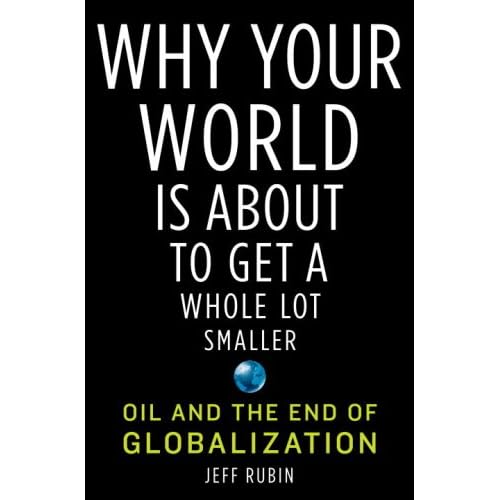
Why Your World Is About to Get a Whole Lot Smaller: Oil and the End of Globalization by Jeff Rubin (On Sale: May 19, 2009) Excerpts:
Cheap oil has been subsidizing the cost of fish. Just like WalMart and Tesco and big-box retailers around the world have been able to cut prices on almost everything by taking advantage of cheap shipping and cheap Asian labor, salmon went from being delicious local seafood to being another global commodity. Cheap oil gives us access to a pretty big world.
In the global economy, no one thinks about distance in miles– they think in dollars. If oil is cheap, it really doesn’t matter how far a factory is from a showroom or a farmer’s field from a supermarket. It’s the cost of other things, like labor or tax, that determines what happens where. An Atlantic salmon caught off the coast of Norway is destined to be moved around the world just like a ball bearing or a microprocessor...
....To get that salmon from the ocean to your plate takes a ridiculous amount of energy. Think of the fuel for the fishing boats, container ships and just- in- time delivery trucks; the energy to freeze and process the fish, to sell it in a supermarket (retail stores use almost as much energy per square foot as factories do, just on heating, cooling and lighting). We invest a lot more energy to get that salmon than we get out of it when we eat it, which in itself makes the fish a bad energy deal. Economics calls it a “diminishing rate of return.”
But it gets worse. A lot worse. All of that energy costs money, and energy gets more expensive just about every day. Not quite every day, of course– the recession that seemed to catch everyone by surprise in 2008 brought oil prices down in spectacular fashion. But even the deepest recessions last barely over a year. Those prices will be on their way back up soon enough. And however you want to measure the energy in that fish– calories, miles, joules, barrels of oil– it is inevitable that the price of fish is going to go up as well...
...what we had just recently seen in oil markets was a harbinger of the future trend in world oil prices. Those high prices (remember when $30 oil seemed alarmingly expensive?) were not some cyclical blip or coincidence of special factors but the beginning of what would prove to be a spectacular rise in oil prices driven by a fundamental imbalance between ever- growing demand and ever- tightening supply conditions...
In today’s oil market, the laws of supply and demand have been turned on their heads. Contrary to the basic precepts of economic theory, global oil demand grew faster during the run- up in oil prices than it did a decade earlier, when prices were roughly a fifth or less of what they were in early 2008. Far from killing demand, record high oil prices seemed to spur ever- greater consumption of oil. And instead of new supply gushing out of the ground, supply growth has basically stopped dead in its track in the face of no less than a fivefold increase in the price of crude. Despite every incentive to pump more, despite calls for OPEC to open the spigots and President Bush’s personal pleas to the Saudis, world production has hardly grown at all since 2005.
Suddenly the textbooks seem to be describing some other world than the one we live in...
...Get ready for a smaller world. Soon, your food is going to come from a field much closer to home, and the things you buy will probably come from a factory down the road rather than one on the other side of the world. You will almost certainly drive less and walk more, and that means you will be shopping and working closer to home. Your neighbors and your neighborhood are about to get a lot more important in the smaller world of the none too-distant future.
07 May 2009
After years of encouraging and pursuing a policy of higher birth rates for Singapore, I was a little surprised to read these comments by MM Lee at a dinner marking the Botanic Gardens' 150th anniversary in TODAYonline (see below). Apparently, even he understands our "sunshine limits to growth". So the question to ask, why does Singapore continue to pursue those very policies of economic and population expansion which will only lead to self-destruction due to the over-exploitation of the earth's resources?
We live in a momentous turning point in the history of human civilization where the converging crises of peak oil, climate change, overpopulation and a broken financial system threaten to throw us into an era marked by elevated levels of violence, crime, pestilence, famine and death. Sadly, many Singaporeans remain blissfully unaware of these impending events. I suspect this ignorance may be attributed in part to the frequent silence of the local media and our culture's over-reliance on the government to "fix it all".
The response of governments around the world has been the exact opposite of what they should be doing to tackle these problems. They have been adding fuel to the fire. Instead of downsizing and cutting back on growth and consumption, we have been urged to spend in order to stimulate the economy to meet growth targets. Replacing the GDP metric with the Genuine Progess Indicator is one of the first steps any country should take to measure true progress and wealth. Instead of "re-localising" our economy and our food and energy production to maximise our resilience to external shocks, we promote globalization and free trade to boost our production efficiency and capacity to the delight of the transnational corporations' bottom lines, but to the detriment of the environment, the middle class and the peasantry.
The Minister Mentor is right, we have outsmarted ourselves. So now i ask him, why is Singapore "still doing these stupid things?"
‘Humans are too clever’
MM LEE: I read an analysis ... This man said, for thousands of years of agricultural societies, the only source of energy was the sun which limits what they can grow, what animals can feed on the grass, what population you can sustain. Then came the industrial revolution ... (driven by) fire and coal. Coal is stored solar energy. Then they found oil; also stored solar energy..
Now ... they got this experiment to make two atoms collide and see whether they can generate power like the sun. So man is trying to generate mini suns, that can go on forever. But when you switch it on the whole thing burns up. So man has not found a way ....
And if we do find out what’s the way, will that solve it? I don’t think so. We’ve become too clever by far. If we find a solution to energy, the world will be overpopulated ... In 50 years, we are expecting 9.5 billion people from 6.3 billion now. You find a new energy source, we’ll become 80 billion people in the next century. Then what?.
So I think sooner or later, the human being must come to terms with the fact that this planet called earth can only sustain so much. You go beyond that, you destroy your habitat..
MODERATOR TOMMY KOH: Haven’t they learnt that already?.
MM LEE: If we’ve learnt that, why are we still doing these stupid things?
http://www.todayonline.com/articles/318489.asp
04 May 2009
A brilliant article which explains how and why the dominant economic paradigm is rooted in unreality and fantasy. The financial "wizards" and economic "high priests" of today rightly deserve to be castigated not only for the current worldwide credit crunch but also for our environmental woes. Our current model of relentless economic growth and accumulation of goods and capital is a recipe for ecological failure on a global scale. The economy is a subset of the ecosystem and not the other way round. Without a hospitable living environment, there can be no economy; hence, ecology precedes economy. I urge you to read the article in its entirety.
LINK: http://www.monthlyreview.org/090501-york-clark-foster.php
An essay mentioned in the article,“Economics Needs a Scientific Revolution,” can be found here: LINK
29 April 2009
Why Singapore's Sustainable Development Blueprint is UNsustainable
3 comments Posted by TM at 9:36 AMSingapore's Inter-Ministerial Committee on Sustainable Development (IMCSD) has unveiled its blueprint for sustainable development. You can download it at: http://app.mewr.gov.sg/data/ImgCont/1292/sustainbleblueprint_forweb.pdf
My impressions? In short, it is inadequate and myopic. It is another step on the road to diminishing returns on investments in social complexity. (See also: New Scientist article)
In spite of the blueprint's laudable efforts and lofty goals to maintain sustainable growth (an oxymoron really) and to promote green living standards, one topic that is sorely missing is any discussion at all about the future availability of dense energy sources, namely fossil fuels, to implement the "four-pronged strategy".
Energy is required for water recycling, purification and desalination, for waste management and recycling, for public transportation, for the construction of green buildings, etc. The big question which is not answered in the blueprint: where will we get the energy to carry out these activities in the next 20 years?
Sure the blueprint talks alot about energy efficiency and technologies, but they should focus on total overall consumption instead. If total overall consumption keeps growing, a finite resource like oil or natural gas will eventually be depleted regardless of how efficiently it is consumed per capita. See charts below.
Sources: EMA, Singstat and E2Singapore
 The blueprint states:
In the past 10 years, households in Singapore consumed 64% more electricity, 21% more water, and generated 21% more solid waste. (p.40)Will technology save us? No, because firstly it will likely result in greater consumption of energy and resources according to "Jevons Paradox," named after the 19th century English economist who observed that the increased efficiency in consumption of a resource tends to increase overall consumption and demand. Secondly, technology runs on energy. All forms of alternative energy depend on energy inputs from shrinking reserves of fossil fuels during the manufacturing process, and due to reasons of complexities of scale, diminishing energy returns, low energy qualities and energy interchangeability challenges, alternative energy supplies can never fully replace fossil fuels. Minister Yaacob Ibrahim, co-chairman of the IMCSD, has acknowledged this fact in the Business Times (28 April 2009, p.32):
"If you ask us whether we can really change our economic structure and replace all the fossil fuels that we import with alternative energy - not possible."Considering that surplus energy is required for growth and complex societies like ours to function smoothly, how shall we live after peak oil if alternative energies are not viable substitutes?
The Export Land Model developed by geologist Jeffrey Brown and others forecasts that the top five net oil exporting countries of the world (Saudi Arabia, Russia, Norway, Iran and the UAE), who presently account for half of the world's net oil exports, will cease to export any oil by 2030 because of rising domestic consumption in their own countries and declining field production. In other words, they will have ZERO oil surpluses for export by 2030; they keep whatever they have for themselves and the rest of the world gets nothing. Actually, we don't even have to wait till 2030 to experience the painful effects because the model projects that their oil exports will be halved by 2015. If you think about that for a minute, the implications are profound and far-reaching; we're talking about distressing adjustments to the way we live, eat, work and play for the next 10-20 years.
Derrick Jensen, author of Endgame, defines a city as "people living more or less permanently in one place in densities high enough to require the routine importation of food and other necessities of life." Singapore certainly fits that description. Because of our excessive reliance on transient supplies of fossil fuels for food and electricity, densely populated cities like Singapore are by nature unsustainable and abnormal in the history of civilisation. William Catton, author of Overshoot, characterises this aberration as a "phantom carrying capacity" - that portion of a population that cannot be permanently supported when temporarily available resources [fossil fuels] become unavailable.
I am a little amazed that our sustainability blueprint for the next 20 years would exclude any major discussions of future energy sources. Just like the Ministry of Trade and Industry's "Energy for Growth - National Energy Policy" report, the sustainable blueprint has been disappointing. IMCSD has failed to connect the dots between the economy and the ecosystem by erroneously believing "that growth and environmental sustainability are compatible and mutually reinforcing (p.78)" and by neglecting any studies on future energy availability.
Fellow Singaporeans, brace yourself for a tumultuous future.
The only viable long term solution? Stop growing. Relocalize and embrace a steady state economy.
28 April 2009
Some Concerns About the Speech by Minister Mah Bow Tan at the Asia Society Conference
0 comments Posted by TM at 9:33 AMAn email that I sent recently....
Sent: Monday, 27 April 2009 4:30:16
Dear MND and MEWR,
As a concerned Singaporean, I am alarmed to read the following in a speech by Minister Mah Bow Tan:
Cities have to ensure that economic growth is not stunted by infrastructure bottlenecks and that growth does not come at the expense of clean air, clean water and a liveable environment. http://www.mnd.gov.sg/newsroom/Speeches/speeches_2009_M_24042009.htmI urge the Minister to reconsider that statement because research done by the authors of the "Limits to Growth", ecological economists and scientists have proven that "there is a fundamental conflict between economic growth and environmental protection, including conservation of biodiversity, clean air and water, and atmospheric stability. This conflict is due to natural laws (thermodynamics and ecological structures) - it is simply a result of the way the world works. Mounting evidence of this conflict demonstrates the limits to growth."
A cursory reading of the daily news reports will tell us that we are loosing biodiversity, fresh water, top soil, and clean air at an unprecedented rate and all of this is due to human economic expansion.
I plead with you to read the following articles and re-examine the growth paradigm which has guided us for at least the last 50 years and come to an understanding that this cannot go on forever. At some point, probably now, we will clash with the earth's ecological limits to sustain itself and Nature always wins. This means that societal collapse and die-offs are inevitable unless we take steps now to descend the growth ladder in a controlled manner, or else massive social dislocation is likely to ensue in the years ahead.
A sustainable Singapore requires a new non-growth paradigm to guide us, not the current one that has left the earth devastated and poorer for future generations.
Revisiting the Limits to Growth After Peak Oil
http://www.esf.edu/efb/hall/2009-05Hall0327.pdf
Economics in a Full World
http://www.publicpolicy.umd.edu/faculty/daly/sciam-Daly5%20copy%201.pdf
Prosperity Without Growth
http://www.sd-commission.org.uk/publications/downloads/prosperity_without_growth_report.pdf
Why our Economy is Killing the Planet
http://www.scribd.com/doc/13482709/Ecological-Economics-Beyond-Growth-Why-Our-Economy-is-Killing-the-Planet-New-Scientist-18-Oct-2008