10 August 2009
Economic growth is all about production and consumption. Economists and politicians love a growing population of consumers because it adds to economic growth. A greying population would slow our growth and so the current 4.6 million on this island is not enough, we need 6.5 million in the coming decades. Now this cycle of growth is vicious and self-perpetuating. In 2030, the government will say 6.5 million of us is not enough, we need 9 million on this island to keep the economy growing. Wash, rinse, repeat.
Spend, spend, spend. Consume, consume, consume. Grow, grow, grow. I remember reading in ChannelNewsAsia last year where SM Goh Chok Tong was encouraging Singaporeans to spend to starve off a recession:"If all of us go into a power save mode, then the economy will really go into a recession! This is what economists called the Paradox of Thrift. If you have sufficient savings and can afford to spend, you should continue to spend on life's little pleasures.
Here's the twist: what are the limits, if any, as to how much we can spend and grow before we turn into an incurable cancerous tumour on this planet? The New Scientist article below addresses this question and our leaders and policymakers would do well to pay attention to this for a truly sustainable Singapore - not the pseudo-sustainable-growth-economy that Mah Bow Tan keeps talking about.
"Take your family to the movies, shop, dine out at restaurants and hawker centres, go for your regular foot massage, indulge yourself at a spa, take a taxi, donate to charity and so on."
New Scientist
07 August 2009
...According to leading ecologists...few of us realise that the main cause of the current environmental crisis is human nature.
...All we're doing is what all other creatures have ever done to survive, expanding into whatever territory is available and using up whatever resources are available, just like a bacterial culture growing in a Petri dish till all the nutrients are used up. What happens then, of course, is that the bugs then die in a sea of their own waste.
...Epidemiologist Warren Hern of the University of Colorado at Boulder, even likened the expansion of human cities to the growth and spread of cancer, predicting "death" of the Earth in about 2025. He points out that like the accelerated growth of a cancer, the human population has quadrupled in the past 100 years, and at this rate will reach a size in 2025 that leads to global collapse and catastrophe...
...The problem..is that it fails to recognise that the physical resources to fuel this growth are finite. "We're still driven by growing and expanding, so we will use up all the oil, we will use up all the coal, and we will keep going till we fill the Petri dish and pollute ourselves out of existence,"
Full Article: Consumerism is 'eating the future'
08 August 2009
The Ministry of Trade and Industry (MTI) published in Nov 2007 (p.13):
For oil and gas, proven reserves are estimated to be sufficient for only around 40 and 63 years of 2006 levels of consumption respectively. Nevertheless, oil and gas production is not expected to peak within the next two to three decades. With more exploration and improvements in extraction technologies, substantial new reserves will be added. Since 1980, globally proven oil reserves have expanded by 81 per cent, while proven gas reserves have more than doubled.I had previously criticized this report for being too optimistic in its oil projections and economic growth outlook because they had taken as face value data published from British Petroleum (BP ) and the International Energy Agency (IEA).
In recent months, the IEA has changed its tune and its chief economist, Dr Fatih Birol, now believes that global peak oil production is likely in the next 10 years. See:
The Independent: Warning: Oil Supplies Are Running Out Fast
TimesOnline: World needs four new Saudi Arabias, warns IEA
The "early peakers" (ASPO and TheOilDrum.com) estimate peak oil to occur between 2005 and 2012. Whichever the date, it's probably too late to make a smooth transition to a post-peak oil world. Alternative energy did not save us during the runup of oil prices from $20/barrel in 1999 to $147 in 2008, and neither will it at $200 or $300 per barrel because the economy would have cratered at those levels hampering the development of these energy projects. Kurt Cobb has a wonderful explanation here: Receding Horizons for Alternative Energy Supplies
It'll be interesting to see what MTI has to say in their next energy report in view of the recent IEA changes. Any attempts to sidestep this issue as the IMCSD did in the Sustainable Development Blueprint and further promote unsustainable growth will only spell disaster in the long term.
07 June 2009
Relocalization, not globalization, is the way forward for Singapore and the rest of the world. However, I doubt that relocalization efforts will take place until we enter the collapse phase of panarchy theory (see article below), but then it might be too late to prevent a societal breakdown. The 2008 oil crisis and financial panic ought to have awaken us to the fragility of a globalized world. Instead we are calling for greater economic integration and free trade - talk about insanity - doing the same thing over and over again and expecting different results. We are sacrificing long term ecological sustainability and balance for short term paper profits. Monetary abstractions will be of little use after we extract and exhaust all the minerals and resources from the earth in this lifetime. This will not end well.
http://www.canada.com/Panarchy+Insights+Into+Civilization/1664491/story.html
As valuable as Dr. Buzz Holling's notion of panarchy theory is in helping us understand the cyclical changes in forests -- the way they move through continuous phases of regeneration, growth, increasing connectivity, and then rigidity, crisis, collapse and regeneration again -- his thinking is much more valuable in helping us identify and correct the same trends occurring in our modern civilization. It, too, is a natural system that has been moving through a growth phase for the last several centuries and is now becoming increasingly interconnected and rigid, conditions that are prelude to a crisis.
Indeed, the course of our globalized world has been following all the adaptive characteristics of Holling's notion of panarchy theory. If he is correct, we are approaching the end of a growth phase, a time when the rising "dependence" within the system, together with increasing specialization and efficiency, create a fatal loss of resilience. As we continue to exploit every possible resource and niche on the planet, our entire socio-economic system loses its adaptive options as it becomes more dependent on the smooth functioning of a rising proportion of its interlinked components. This "peaking", Holling contends, usually leads to a collapse.
As a measure of our vulnerability, simply choose a few examples of the cumulative effects that can be caused by any single disruption:
- Just one crash on a freeway stops traffic, creates huge jams and leaves thousands of commuters and transporters delayed for hours.
- Contamination at just one processing plant taints food supplies across a continent.
- A malfunction at one nuclear power plant almost eliminates the supply of critically important medical isotopes.
- One terrorist attack inflicts huge amounts of fear and a country spends billions of dollars on measures to prevent the repeat of such an event.
- Just the hint of a pandemic raises global panic, devastates tourist industries and slows international travel for months.
- A policy of unregulated mortgages in the US triggers a subprime crisis that spreads throughout the international financial system, undermining confidence in money markets and sending the global economy into a tailspin.
- Our nearly total dependence on a supply of cheap oil for transportation, innumerable consumer products and nearly half our food production transforms any hint of a shortage into convulsions of worry and nightmares of consequence.
- The excessive emission of a single gas, carbon dioxide, threatens to alter the planet's climate, displace hundreds of millions of people, induce droughts and restructure global economies.
Indeed, the very efficiency of our global economic system, an attribute we herald as a virtue, is victimizing the planet's ecology. Maximizing performance and productivity drives the continual expansion of the world's economy. "Based on current trends," writes Thomas Homer-Dixon, "global output of goods and services will quadruple from US $60 to $240 trillion (in 2005 dollars) by 2050" (WorldWatch, March/April, 2009).
Panarchy theory argues that this kind of growth eventually self destructs. A civilization, like an athlete trying to run ever faster, needs progressively more energy to maintain itself. The system collapses when the energy return falls below the energy invested. The Roman Empire failed, Homer-Dixon suggests, because it became too complex to be supported by its food-based energy system. How, then, are we to reconcile rising growth with falling energy supplies?
Panarchy theory -- and even common sense -- dictates that the growth phase of any adaptive cycle cannot continue indefinitely. Continuous growth may seem possible when we are wholly emersed in the euphoria of it. This is why the insightful perspective of such people as Buzz Holling are so important -- and so disturbing.
In Holling's assessment of our history, "This is a moment of great volatility and instability in the world system. We need urgently to do what we can to avoid deep collapse. We also need to figure out how to exploit the opportunity provided by crisis and collapse when they occur, because some kind of systemic breakdown is now almost certain" (Ibid).
Holling makes two crucially important points here. The first purpose of panarchy theory is to identify the behaviour that is leading to collapse and, therefore, to use the forewarning to avoid the unwelcome outcome that it predicts. The second is to prepare for the collapse by minimizing the impact.
Some people have already started to prepare for this eventuality, as if a subliminal consciousness were already sensing an impending danger.
Globalization is losing its allure. Countries are moving toward greater self-sufficiency. Agricultural land is being protected, resources considered and ecologies preserved. Food security is prompting local buying and home gardens -- community gardens are appearing in many urban and rural neighbourhoods. Young people are returning to old farms to restore the fields with vegetable crops. Organics are on the rise.
Cycling is popular and is being encouraged for commuting in most cities.
Cars are getting smaller and more efficient. The indications of awareness are everywhere.
These steps, of course, are just the beginning of the beginning. But the signs are evident. The marvel that many people hold for our modern civilization now comes coupled with a pervasive apprehension. Perhaps panarchy theory offers some clarifying insights about what is amiss and what we might do.
http://www.canada.com/Panarchy+Insights+Into+Civilization/1664491/story.html
03 June 2009
To sustain growth and vitality in our economy, we need a growing population in Singapore with talents in every field. -- PM Lee Hsien Loong in the 2006 National Day RallyContrast the above statement with an interesting speech given by former Senior Minister of State for Foreign Affairs of Singapore, Dr. Ow Chin Hock, in 1978 at the opening of the Family Planning Association.
At the national level, a large population not only means greater demand for jobs and for social infrastructure such as education, housing, medical and health services. It also means that the material gains accruing from economic development have to be shared by a larger number of people, resulting in lower living standards for everyone. Thus, Two Is Enough is not a mere slogan. ‘It is the responsibility of every parent and citizen to ' put it into practice. -- Dr. Ow Chin HockI fully agree with Dr. Ow here. He makes alot more sense than our present Singapore leaders who worship at the altar of unlimited growth, which will soon be kept in check by a finite resource base.
Growth Does Not Equal Prosperity!
Speech by Dr. Ow Chin Hock on Family Planning (1978)
01 June 2009
Geologist Colin Campbell made a number of astute observations in this 2005 video interview (below) about oil and the financial system. We have to wake up to the fact that we are nearing or at the end of growth.
The boom time of the last 50 years was based on cheap oil which is now coming to an end. The end of growth threatens to bring down our debt-based monetary system which is founded on economic growth to pay off interest-bearing debt obligations.
We can expect decade-long, unprecedented market gyrations and volatility as central bankers resort to every trick in the economic textbooks and their magic bags to starve off a recession. They will ultimately fail because unlike credit, they can't create oil and natural resources out of thin air.
Dear bankers, welcome back to biophysical reality.
Unfortuantely, the growth mentality is still deeply entrenched in our government as can been seen from the Prime Minister's speech in Parliament (27 May '09):
At the broadest level, our approach to economic development and to growth remains valid. We have to stay open to trade and global competition.The opposition leader Low Thia Khiang, seemingly oblivious to the relationship between cheap oil and globalization, fares no better:
So the question is how do we encourage energy conservation to grow more sustainably and to be less affected when energy prices go up from time to time, all in the long term?
The Workers’ Party chief and Hougang MP defended the long-held growth model, saying in Mandarin: ‘I believe it is correct to attract foreign investments to encourage competition in a free market, to open up our market and to go global and…integrate with the global economy.’It won't be easy to discard this mentality until we hit a more severe oil crisis of some kind in the near future to awaken us.
Two economists, Jeff Rubin and James Hamilton, have concluded that the current recession was caused by oil spikes.
Graph Source: http://www.theoildrum.com

Colin Campbell Interview:
The first half of the age of oil saw the rapid expansion of industry, transport, trade, agriculture - all of those things allowed the population to expand six-fold. So you have this enormous and brief chapter in history of this rapid expansion, and included in that thing is financial capital....
..the banks lend more than they have in deposit...the banks had confidence that the resulting expansion of all of this investment in debt and loans and everything was sufficient collateral for today's debt...
So expansion tomorrow covered the debt of today.
..But unseen by anybody or unrecognized was that this expansion was not just money. It was the good old cheap energy (oil) to make the wheels turn and do everything. So we now face a situation when the bankers begin to wake up and say "well this expansion cannot go on anymore without the cheap energy to make it happen". That means that the massive amount of debt throughout the world is loosing its collateral...
...[Bankers] will wake up and say "we got bad debt on our hands"....
Every single company market quoted on the stock market have a tacit business-as-usual assumption of continuing cheap easy oil such as they have known in their business. So once you realise that this cheap abundant easy oil isn't there, that tells you that virtually every company quoted on the stock market is now overvalued. There has to be some radical readjustment and capital really has to be reduced in some way to match the declining energy supply that on which it eventually depends. So this is the kind of crisis that is staring us in the face...
13 May 2009
It is not unthinkable that we may soon say goodbye to the era of 1500 mile Thai rice, 3000 mile Australian lamb loin chops, 4000 mile New Zealand strip loins, 9000 mile Namibian seafood, and 10,000 mile Norwegian Salmon Fillet in Cold Storage and NTUC Fairprice. Why? Because triple-digit oil prices are going to drive up transportation costs to such an extent that it will be more sensible and affordable to grow our own food. Distance is going to matter again and globalization - the economic integration of nations through unrestricted flow of goods and services - will be reversed with the end of cheap oil.
What will we eat? Our food security is at stake and what is the Agri-Food & Veterinary Authority of Singapore (AVA) doing about it? Their key strategy is to diversify by sourcing from countries as far away as Namibia and Chile. Will this work? No because it still depends on oil for transportation and food producing nations will move to curb exports as we witnessed in 2008 when high food prices forced governments to take action to quell local anxieties; therefore, it is important to substantially increase local food production to guarantee uninterrupted food supplies. Regrettably, AVA is not pursuing the self sufficient route.
Jeff Rubin, chief economist at CIBC World Markets, has written a timely book about peak oil and the end of globalization. It deserves our attention because Singapore's economy is so dependent on trade that we are highly vulnerable to oil shocks. Unlike the 1970s, the next oil shock will be permanent without any recovery in sight - a permanent recession caused by a relentless decline in global oil production. What is worrying is that the Singapore government does not appear to have any detailed contingency plans for peak oil. My email queries to government ministries have only elicited standard template replies like the following:
From: Ministry of Trade and IndustryMany Singaporeans will be in for a rude shock, which will be compounded by the current absence or lack of coverage of these issues by the local media, when they realise how long lasting this crisis will be.
With no indigenous energy resources of our own, we are price-takers and dependent on global markets for our energy resources. Thus, an essential part of our energy security strategy is to diversify our sources of supply, and in the long run, to diversify our fuel types. We have decided to pursue the import of LNG from 2012. We are test-bedding new and renewable energy technologies, and are keeping a watching brief on emerging energy technologies that may become viable for Singapore in the long run.
We would like to thank you for your constructive feedback.
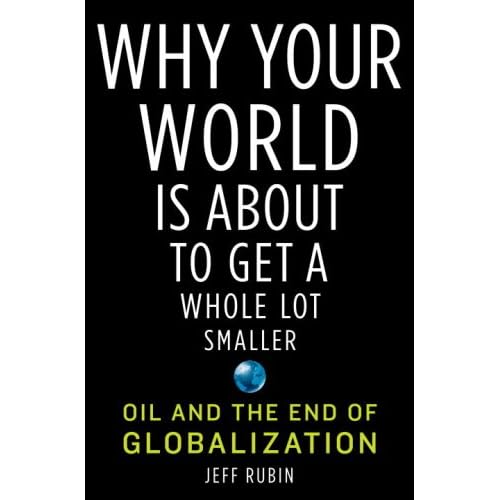
Why Your World Is About to Get a Whole Lot Smaller: Oil and the End of Globalization by Jeff Rubin (On Sale: May 19, 2009) Excerpts:
Cheap oil has been subsidizing the cost of fish. Just like WalMart and Tesco and big-box retailers around the world have been able to cut prices on almost everything by taking advantage of cheap shipping and cheap Asian labor, salmon went from being delicious local seafood to being another global commodity. Cheap oil gives us access to a pretty big world.
In the global economy, no one thinks about distance in miles– they think in dollars. If oil is cheap, it really doesn’t matter how far a factory is from a showroom or a farmer’s field from a supermarket. It’s the cost of other things, like labor or tax, that determines what happens where. An Atlantic salmon caught off the coast of Norway is destined to be moved around the world just like a ball bearing or a microprocessor...
....To get that salmon from the ocean to your plate takes a ridiculous amount of energy. Think of the fuel for the fishing boats, container ships and just- in- time delivery trucks; the energy to freeze and process the fish, to sell it in a supermarket (retail stores use almost as much energy per square foot as factories do, just on heating, cooling and lighting). We invest a lot more energy to get that salmon than we get out of it when we eat it, which in itself makes the fish a bad energy deal. Economics calls it a “diminishing rate of return.”
But it gets worse. A lot worse. All of that energy costs money, and energy gets more expensive just about every day. Not quite every day, of course– the recession that seemed to catch everyone by surprise in 2008 brought oil prices down in spectacular fashion. But even the deepest recessions last barely over a year. Those prices will be on their way back up soon enough. And however you want to measure the energy in that fish– calories, miles, joules, barrels of oil– it is inevitable that the price of fish is going to go up as well...
...what we had just recently seen in oil markets was a harbinger of the future trend in world oil prices. Those high prices (remember when $30 oil seemed alarmingly expensive?) were not some cyclical blip or coincidence of special factors but the beginning of what would prove to be a spectacular rise in oil prices driven by a fundamental imbalance between ever- growing demand and ever- tightening supply conditions...
In today’s oil market, the laws of supply and demand have been turned on their heads. Contrary to the basic precepts of economic theory, global oil demand grew faster during the run- up in oil prices than it did a decade earlier, when prices were roughly a fifth or less of what they were in early 2008. Far from killing demand, record high oil prices seemed to spur ever- greater consumption of oil. And instead of new supply gushing out of the ground, supply growth has basically stopped dead in its track in the face of no less than a fivefold increase in the price of crude. Despite every incentive to pump more, despite calls for OPEC to open the spigots and President Bush’s personal pleas to the Saudis, world production has hardly grown at all since 2005.
Suddenly the textbooks seem to be describing some other world than the one we live in...
...Get ready for a smaller world. Soon, your food is going to come from a field much closer to home, and the things you buy will probably come from a factory down the road rather than one on the other side of the world. You will almost certainly drive less and walk more, and that means you will be shopping and working closer to home. Your neighbors and your neighborhood are about to get a lot more important in the smaller world of the none too-distant future.
07 May 2009
After years of encouraging and pursuing a policy of higher birth rates for Singapore, I was a little surprised to read these comments by MM Lee at a dinner marking the Botanic Gardens' 150th anniversary in TODAYonline (see below). Apparently, even he understands our "sunshine limits to growth". So the question to ask, why does Singapore continue to pursue those very policies of economic and population expansion which will only lead to self-destruction due to the over-exploitation of the earth's resources?
We live in a momentous turning point in the history of human civilization where the converging crises of peak oil, climate change, overpopulation and a broken financial system threaten to throw us into an era marked by elevated levels of violence, crime, pestilence, famine and death. Sadly, many Singaporeans remain blissfully unaware of these impending events. I suspect this ignorance may be attributed in part to the frequent silence of the local media and our culture's over-reliance on the government to "fix it all".
The response of governments around the world has been the exact opposite of what they should be doing to tackle these problems. They have been adding fuel to the fire. Instead of downsizing and cutting back on growth and consumption, we have been urged to spend in order to stimulate the economy to meet growth targets. Replacing the GDP metric with the Genuine Progess Indicator is one of the first steps any country should take to measure true progress and wealth. Instead of "re-localising" our economy and our food and energy production to maximise our resilience to external shocks, we promote globalization and free trade to boost our production efficiency and capacity to the delight of the transnational corporations' bottom lines, but to the detriment of the environment, the middle class and the peasantry.
The Minister Mentor is right, we have outsmarted ourselves. So now i ask him, why is Singapore "still doing these stupid things?"
‘Humans are too clever’
MM LEE: I read an analysis ... This man said, for thousands of years of agricultural societies, the only source of energy was the sun which limits what they can grow, what animals can feed on the grass, what population you can sustain. Then came the industrial revolution ... (driven by) fire and coal. Coal is stored solar energy. Then they found oil; also stored solar energy..
Now ... they got this experiment to make two atoms collide and see whether they can generate power like the sun. So man is trying to generate mini suns, that can go on forever. But when you switch it on the whole thing burns up. So man has not found a way ....
And if we do find out what’s the way, will that solve it? I don’t think so. We’ve become too clever by far. If we find a solution to energy, the world will be overpopulated ... In 50 years, we are expecting 9.5 billion people from 6.3 billion now. You find a new energy source, we’ll become 80 billion people in the next century. Then what?.
So I think sooner or later, the human being must come to terms with the fact that this planet called earth can only sustain so much. You go beyond that, you destroy your habitat..
MODERATOR TOMMY KOH: Haven’t they learnt that already?.
MM LEE: If we’ve learnt that, why are we still doing these stupid things?
http://www.todayonline.com/articles/318489.asp
04 May 2009
A brilliant article which explains how and why the dominant economic paradigm is rooted in unreality and fantasy. The financial "wizards" and economic "high priests" of today rightly deserve to be castigated not only for the current worldwide credit crunch but also for our environmental woes. Our current model of relentless economic growth and accumulation of goods and capital is a recipe for ecological failure on a global scale. The economy is a subset of the ecosystem and not the other way round. Without a hospitable living environment, there can be no economy; hence, ecology precedes economy. I urge you to read the article in its entirety.
LINK: http://www.monthlyreview.org/090501-york-clark-foster.php
An essay mentioned in the article,“Economics Needs a Scientific Revolution,” can be found here: LINK
29 April 2009
Why Singapore's Sustainable Development Blueprint is UNsustainable
3 comments Posted by TM at 9:36 AMSingapore's Inter-Ministerial Committee on Sustainable Development (IMCSD) has unveiled its blueprint for sustainable development. You can download it at: http://app.mewr.gov.sg/data/ImgCont/1292/sustainbleblueprint_forweb.pdf
My impressions? In short, it is inadequate and myopic. It is another step on the road to diminishing returns on investments in social complexity. (See also: New Scientist article)
In spite of the blueprint's laudable efforts and lofty goals to maintain sustainable growth (an oxymoron really) and to promote green living standards, one topic that is sorely missing is any discussion at all about the future availability of dense energy sources, namely fossil fuels, to implement the "four-pronged strategy".
Energy is required for water recycling, purification and desalination, for waste management and recycling, for public transportation, for the construction of green buildings, etc. The big question which is not answered in the blueprint: where will we get the energy to carry out these activities in the next 20 years?
Sure the blueprint talks alot about energy efficiency and technologies, but they should focus on total overall consumption instead. If total overall consumption keeps growing, a finite resource like oil or natural gas will eventually be depleted regardless of how efficiently it is consumed per capita. See charts below.
Sources: EMA, Singstat and E2Singapore
 The blueprint states:
In the past 10 years, households in Singapore consumed 64% more electricity, 21% more water, and generated 21% more solid waste. (p.40)Will technology save us? No, because firstly it will likely result in greater consumption of energy and resources according to "Jevons Paradox," named after the 19th century English economist who observed that the increased efficiency in consumption of a resource tends to increase overall consumption and demand. Secondly, technology runs on energy. All forms of alternative energy depend on energy inputs from shrinking reserves of fossil fuels during the manufacturing process, and due to reasons of complexities of scale, diminishing energy returns, low energy qualities and energy interchangeability challenges, alternative energy supplies can never fully replace fossil fuels. Minister Yaacob Ibrahim, co-chairman of the IMCSD, has acknowledged this fact in the Business Times (28 April 2009, p.32):
"If you ask us whether we can really change our economic structure and replace all the fossil fuels that we import with alternative energy - not possible."Considering that surplus energy is required for growth and complex societies like ours to function smoothly, how shall we live after peak oil if alternative energies are not viable substitutes?
The Export Land Model developed by geologist Jeffrey Brown and others forecasts that the top five net oil exporting countries of the world (Saudi Arabia, Russia, Norway, Iran and the UAE), who presently account for half of the world's net oil exports, will cease to export any oil by 2030 because of rising domestic consumption in their own countries and declining field production. In other words, they will have ZERO oil surpluses for export by 2030; they keep whatever they have for themselves and the rest of the world gets nothing. Actually, we don't even have to wait till 2030 to experience the painful effects because the model projects that their oil exports will be halved by 2015. If you think about that for a minute, the implications are profound and far-reaching; we're talking about distressing adjustments to the way we live, eat, work and play for the next 10-20 years.
Derrick Jensen, author of Endgame, defines a city as "people living more or less permanently in one place in densities high enough to require the routine importation of food and other necessities of life." Singapore certainly fits that description. Because of our excessive reliance on transient supplies of fossil fuels for food and electricity, densely populated cities like Singapore are by nature unsustainable and abnormal in the history of civilisation. William Catton, author of Overshoot, characterises this aberration as a "phantom carrying capacity" - that portion of a population that cannot be permanently supported when temporarily available resources [fossil fuels] become unavailable.
I am a little amazed that our sustainability blueprint for the next 20 years would exclude any major discussions of future energy sources. Just like the Ministry of Trade and Industry's "Energy for Growth - National Energy Policy" report, the sustainable blueprint has been disappointing. IMCSD has failed to connect the dots between the economy and the ecosystem by erroneously believing "that growth and environmental sustainability are compatible and mutually reinforcing (p.78)" and by neglecting any studies on future energy availability.
Fellow Singaporeans, brace yourself for a tumultuous future.
The only viable long term solution? Stop growing. Relocalize and embrace a steady state economy.
28 April 2009
Some Concerns About the Speech by Minister Mah Bow Tan at the Asia Society Conference
0 comments Posted by TM at 9:33 AMAn email that I sent recently....
Sent: Monday, 27 April 2009 4:30:16
Dear MND and MEWR,
As a concerned Singaporean, I am alarmed to read the following in a speech by Minister Mah Bow Tan:
Cities have to ensure that economic growth is not stunted by infrastructure bottlenecks and that growth does not come at the expense of clean air, clean water and a liveable environment. http://www.mnd.gov.sg/newsroom/Speeches/speeches_2009_M_24042009.htmI urge the Minister to reconsider that statement because research done by the authors of the "Limits to Growth", ecological economists and scientists have proven that "there is a fundamental conflict between economic growth and environmental protection, including conservation of biodiversity, clean air and water, and atmospheric stability. This conflict is due to natural laws (thermodynamics and ecological structures) - it is simply a result of the way the world works. Mounting evidence of this conflict demonstrates the limits to growth."
A cursory reading of the daily news reports will tell us that we are loosing biodiversity, fresh water, top soil, and clean air at an unprecedented rate and all of this is due to human economic expansion.
I plead with you to read the following articles and re-examine the growth paradigm which has guided us for at least the last 50 years and come to an understanding that this cannot go on forever. At some point, probably now, we will clash with the earth's ecological limits to sustain itself and Nature always wins. This means that societal collapse and die-offs are inevitable unless we take steps now to descend the growth ladder in a controlled manner, or else massive social dislocation is likely to ensue in the years ahead.
A sustainable Singapore requires a new non-growth paradigm to guide us, not the current one that has left the earth devastated and poorer for future generations.
Revisiting the Limits to Growth After Peak Oil
http://www.esf.edu/efb/hall/2009-05Hall0327.pdf
Economics in a Full World
http://www.publicpolicy.umd.edu/faculty/daly/sciam-Daly5%20copy%201.pdf
Prosperity Without Growth
http://www.sd-commission.org.uk/publications/downloads/prosperity_without_growth_report.pdf
Why our Economy is Killing the Planet
http://www.scribd.com/doc/13482709/Ecological-Economics-Beyond-Growth-Why-Our-Economy-is-Killing-the-Planet-New-Scientist-18-Oct-2008
25 March 2009
19 February 2009
This is an excellent video which explains Hubbert's peak theory when applied to other natural resources besides oil - peak uranium, peak copper, peak coal, etc. Those who argue that peak oilers habour unfounded fears about the future because we have hundreds of years of coal and uranium deposits that we can rely on often overlook the principle of net energy (EROEI/EROI) and diminishing ore grades. Chris Martenson has done a superb job of explaining in his videos the current crises and connection between the economy, the environment and energy. I encourage everyone to visit his website at http://www.chrismartenson.com/crashcourse and register (it's free) to view his videos in high resolution.
06 February 2009
A hundred years ago, markets ruled: fortunes were made, workers abused, bubbles blown. The Austrian School of economists, led by Ludwig von Mises, said this was fine: despite temporary messiness, the market knows best. But the messiness of markets was unacceptable to socialists, some of whom led a revolution in Russia to establish the first state-controlled, planned economy.
The catastrophes of the Great War and The Great Depression led to the ascendancy of John Maynard Keynes, who argued that even capitalist economies need regulation to avert manias and subsequent implosions.
Keynesianism then reigned, as Britain, the US, and most other countries adopted regulations on banking, finance, and industry, in many cases nationalizing railways and other central features of the productive economy.
Meanwhile, rival economist Friedrich von Hayek quietly plotted the Austrian School’s revenge, the occasion for which was offered by stagflation and labour unrest in the 1970s. Von Hayek, who had toiled in obscurity, was now the man of the hour; his acolytes Margaret Thatcher and Ronald Reagan promised to show the way back to prosperity: government was the problem and privatisation the solution!
The ensuing three decades have seen economists crowding back to the ‘Let Markets Rule’ side of the ship, as they giddily praised the wonders of globalisation and free trade.
Since the Collapse of 2008, economists are rushing to announce a new era of neo-Keynesianism: lack of regulation in the finance industry has led us to the brink and only massive government intervention can put us back on track.
Sadly, this time the tracks are gone. The great economic paradigms simply took too much for granted. They assumed that economies run on money and labour, but ignored the roles of energy and ecosystems. They assumed that because population, resource extraction, and available energy had grown throughout the 19th and 20th centuries, they would grow in perpetuity once the proper relations between money, market forces and government regulation were worked out. Almost no one stopped to think that limits to Earth’s atmospheric carbon sinks and supplies of fossil fuels, topsoil and water might impose ultimate limits on economic activity.
The fields of ecological economics and biophysical economics have sprung up to fill in this blind spot of conventional economic thinking, but both are currently marginalised.
In the months ahead we will see a titanic battle over who can restore the beatific condition of perpetual growth. Sadly, neither free marketers nor state controllers have the answer. Humanity has reached physical limits to growth - peak oil and climate change - that spell ruin to all economic philosophies that fail to take such limits into account.
How long will it take the theoreticians to figure this out? How much of our remaining wealth will they destroy in a futile attempt to prove their paradigms eternally true? How far will society unravel before someone in charge begins to question the received wisdom?
Best hopes for quick learning.
Richard Heinberg is a Senior Fellow of the Post Carbon Institute and author of Peak Everything
Source: http://www.theecologist.org/pages/archive_detail.asp?content_id=2084
31 January 2009
My Thoughts on William Choong's Article on Nuclear Energy in Singapore
0 comments Posted by TM at 9:15 AMWilliam Choong, senior writer for The Straits Times, wrote about the need to "re-embrace the atom" (28 Jan'09, ST). I sent him a short email which you can find in part below. Let's bear in mind that nuclear power is no substitute for oil when it comes to the production of petrochemicals, plastics and pesticides, etc. (I'm not saying that the writer is implying that going nuclear is the solution to all our problems). You can read his piece here: Straits Times or WildSingaporeNews.
Hi William,
With reference to your article on nuclear energy in today's ST, the problems you neglected to mention and which I feel are important are Energy Returned On Energy Invested (EROI or EROEI) and Peak Oil.
I assume you are familiar with these two concepts. If not please read
http://www.energybulletin.net/primer and http://www.eroei.com/articles/the-chain/what-is-eroei/
It takes energy to acquire energy. The entire nuclear cycle from the planning stages, to the building and construction phase, to the mining and enrichment of uranium and disposing of waste is highly dependent on fossil fuels, namely crude oil. So you can't say nuclear energy is in anyway "non-carbon" or free of "greenhouse gases". If ASPO is correct, we should see world oil production begin to decline within the next five years. It's currently on a plateau. When that happens, the energy returned (EROI) from nuclear power is expected to decline and it may no longer be feasible to run nuclear plants. [ Studies on the EROI for nuclear energy vary widely, see http://www.theoildrum.com/node/3877 ]
Why is EROI so important you ask?
Because the production of goods and services is a work process, economies with access to higher EROI fuel sources have greater potential for economic expansion and/or diversification. The history of the expansion of human civilization and its material standard of living is directly linked to, but not caused by, successive access to and development of fuel sources with increasingly greater EROI. The transitions from animate energy sources such as plant biomass, and draft animals, to wind and water power, to fossil fuels and electricity enabled increases in per capita output due to increases in the quantity of fuel available to produce non-energy goods. The transition to higher EROI fuels also enabled social and economic diversification as increasingly less available energy was used in the energy securing process, meaning more fuel was available to support non-extractive activities. Much of inter- and intra-society conflicts can in fact be traced to struggles for control over the disposition of energy surplus. LINKHubbert's Peak Oil theory can also be appled to uranium deposits. Some say that uranium supplies peaked in 1980, others say it will peak in 2035, and still others say it won't peak for many hundreds of years. If uranium does peak within 25 years, then we would certainly face difficulties sourcing for uranium to power nuclear plants.
See http://en.wikipedia.org/wiki/Peak_uranium
Instead of thinking of ways to source for low-carbon energy to fuel our economic and population growth paradigms, we ought to ask ourselves if this is sustainable or possible in a finite world. Ecological/Biophysical economists are calling for a paradigm shift in the world of mainstream neoclassical economics. They have proposed a Steady State framework and I believe it provides answers to our future.
http://www.steadystate.org/CASSEFAQs.html
http://www.theoildrum.com/node/3941
I wrote about this some time ago to the ST Forum http://www.straitstimes.com/print/ST%2BForum/Story/STIStory_172145.html
28 January 2009
Unsustainable Economic Growth - Economics In A Full World by Herman Daly (Scientific American Sep 2005)
0 comments Posted by TM at 11:00 AMSome people think that a sustainable economy should sustain the rate of growth of GDP. According to this view, the sustainable economy is equivalent to the growth economy, and the question of whether sustained growth is biophysically possible is begged. The political purpose of this stance is to use the buzzword “sustainable” for its soothing rhetorical effect without meaning anything by it. -- Herman Daly
Ecological Economics in a Full World by Herman Daly _SCIAM Sep 2005_ -
05 December 2008
Irish Times
By John Gibbons
Growth and the pursuit of growth is the secular religion of the western world, and its dogma is infecting every society.
BRIAN COWEN and Enda Kenny suffer from this. So does Gordon Brown and at least nine in 10 other world leaders. All are labouring under the same crippling psychosis. This is their shared conviction that, whatever the problem, the solution lies in economic growth.
So deeply ingrained has the notion of relentless, limitless growth become that to suggest that it may be the cause of, rather than the solution to, our greatest challenges borders on heresy.
Growth and the pursuit of growth is the secular religion of the western world, and its dogma is gradually infecting every society on Earth via globalisation. Every cult needs its clergy, and the high priests of growth are our economists. Purporting to understand such magic as the "hidden hand of the marketplace", economists have been feted by presidents and parliaments as the new alchemists, with their dazzling theories suffused with the promise of technological transubstantiation that will somehow lift us beyond the mortal limits of our fragile blue planet.
These sorcerers have led politicians and populations alike to believe that they alone understood and could tame the raging marketplace, while extracting from it an infinity of goods to sate our ever-expanding appetites.
Perhaps their greatest sleight of hand has been in selling the notion of infinite growth within a finite - and sharply declining - ecosystem. Take Robert Solow, a Nobel Prize-winning US economist. "The world can, in effect, get along without natural resources," was his breathtakingly myopic analysis.
Ask an economist to value a forest, and he'll tell you how much timber sells by the tonne. The Amazon releases 20 billion tonnes of water into the atmosphere every day, free of charge. Forests control floods, purify water, protect biodiversity and keep the planet habitable, but what does this matter to a hedge fund manager? Another trick, called temporal discounting, allows economists to sell our children's future down the heavily polluted river in favour of short-term profit.
Yet this analytical vacuity is the norm, not the exception, among the economic elite. Alan Greenspan, former chairman of the US Federal Reserve, dressed up political ideology and passed it off as rational economics, while cheerfully choreographing the world's greatest financial crisis since the 1930s. None of this has dented the collective self-confidence of the ruling cabal of economists, nor cooled the media's love affair with them.
Tune in to RTÉ or Today FM any day of the week to hear the very economists who sold us the poison during the boom years; now they are peddling their repackaged "cures" in the form of the latest economic elixirs of growth. Heavy drinkers will be familiar with this logic: it's called the hair of the dog.
In nature, growth is a phase, leading to the equilibrium of maturity. An adult that continues growing can only do so by becoming obese. Within the body, cells that multiply exponentially in an otherwise stable organism are more commonly known as a cancerous growth or tumour. The World Wildlife Fund's Living Planet Index has tracked the ecological health of the world since 1970. Its 2008 report found that total planetary resources have been permanently depleted by 30 per cent in well under four decades.
"The possibility of financial recession pales in comparison to the looming ecological crunch," said the fund. The report found that three in four people live in countries that have exceeded their own ecological limits. Ireland is well up the debtor list. We consume resources requiring three times the amount of land actually available globally per person. We are ecologically as well as economically in hock. You really wouldn't want to be around when this debt is called in.
For now, we continue propping up our house of cards by rapidly running down the ecological capital of other countries to maintain our astonishing bubble of affluence. In famine times, this was called eating the seed corn. When our political elite, guided by their hierarchy of economics believe they can cure the recession by "jump-starting" the consumption-driven economy and so plunge us deeper into ecological debt, you see just how the cancer cult of growth economics has metastasised throughout the body politic.
Capitalism, in the words of John Maynard Keynes, an economist now back in vogue having been deemed passé by the seeming triumph of right-wing political ideology, "is the astounding belief that the most wickedest of men will do the most wickedest of things for the good of everybody".
Many people who live in man-made environments like cities may wonder what ecology has got to do with them. Put simply, our environment is to human survival and wellbeing what water is to a fish. If growth is toxic, what about the alternatives? In 1972, a group called the Club of Rome published its prescient book, The Limits to Growth .
Reaching what they call equilibrium would require hard choices. We would have to trade some freedoms, such as the right to have unlimited population growth and resource consumption, "for other freedoms, such as relief from pollution and crowding and the threat of collapse of the world system".
In the 36 years since its publication, Earth now bends under the burden of an additional 3.3 billion people. As we fret about declining property prices, philosopher Henry David Thoreau's observation was never truer: "What good is a house, if you haven't got a tolerable planet to put it on?"
19 September 2008
An excellent summary by George Mobus of just what is wrong with our financial and economic systems. Go to his blog for more details and read the discussions on TheOilDrum. Now if only those imbecilic bankers and economists who advise our politicians and run our financial institutions would pay greater attention to such writings, our world would be a better place.
1) ALL economic activity is work in the physical sense.
2) ALL work requires the flow of energy from a high potential source, through the work process, to a low potential sink.
3) The guidance of energy flow through the work process requires knowledge (of the process and its control model) and information regarding the energy potential available.
4) In the economy money acts as an information token representing the availability of energy to do work at the micro level.
5) Monetary policies have been crafted to disconnect the meaning of money as energy available to do useful work; money is now a commodity a-la Friedman. Money no longer serves as a measure of available energy. Though its flow, counter to actual energy flow, still acts to guide presumptive energy flow.
6) Fractional reserve banking, loaning some portion of an account to a borrower on the idea that the borrower will use that money as if there were energy to do useful work (unconsciously of course) and produce some additional wealth worked as long as net energy (ERoEI) was increasing over time.
7) Until at least the 1970s net energy had been increasing over time, hence the credit system worked because the debt could, in theory, be paid back in a subsequent time period due to the net increase in wealth-production potential.
8) With the advent of production of harder to obtain (lower ERoEI) oil, net energy gain started to decline (creating the top deflection in the peak curve). As net energy gain started to decline it became increasingly difficult to have an increase in wealth-production capacity -- it became harder to repay loans.
9) Since money value had been decoupled from energy available to do work the signal that loans would be harder to pay back was lost.
10) Sometime between the end of the 70' and into the 80's we found it necessary to continue what amounts to a re-financing scheme, chasing more debt to cover previous debt (note: this is also tied to incomes as evidenced in the growing need for two or more wage earners per household and a lot of corporate merger activities, etc.).
11) In order to generate caches of money to appear as if wealth was being created, market manipulations and speculation took on its own life. 'Sophisticated' schemes (slights of hand) have been invented to keep the illusion that wealth is being created -- now defined in monetary terms rather than hard assets with fixed values. But the wealth is just marks on paper (or registers in a computer memory). Real wealth has been in decline, e.g. the infrastructure decay.
12) With the peak of oil production (or plateau) the total net energy available to do work is starting its downward slide. All borrowing against a future when there would be more, not less, energy is futile. There is no PHYSICAL way that those loans can be paid back. All financial schemes that are based on debt being repaid are doomed to failure. The First Law of Thermodynamics is rather clear on this account. You cannot create energy out of nothing.
We humans are a smug bunch. We actually think that money is some social construct that has meaning beyond a physical reality. We've operated on that assumption and now the piper will be paid.
None of the financial geniuses that currently spout their theories are able to explain what is happening. They cannot predict what will come next. They talk about a "bottom" for this or that market. But there is no bottom as long as net energy is in decline. When total energy really starts to decline (post-peak oil) the s**t will really hit the fan.
01 August 2008
A succinct criticism of modern economics by Clive Ponting in A New Green History of the World, pp. 132-135. I heartily recommend this book which I borrowed from the Singapore National Library. It is a stimulating, concise overview of civilizations' impact on the environment.
There is a fundamental flaw in classical economics and all the modern systems derived from it -- Marxist, welfare, Keynesian and modern ultra-liberal economics. They all deal only with the secondary problem of the distribution of scarce resources between competing ends and how the optimal allocation of resources can be achieved. The resources of the earth are treated as capital - a set of assets to be turned into a source of profit. Trees, wildlife, minerals, water and soil are simply commodities to be sold or developed. More important, their price is simply the cost of extracting them and turning them into marketable commodities. Yet this view ignores the basic fact that the resources of the earth are not just scarce, they are finite. Economics is unable to incorporate this fact into its analysis and so the economic systems based upon it encourage both the producer and the consumer to use up resources at whatever rate current market conditions dictate. Economics assumes, in defiance of all logic, that resources, in terms of land, materials and energy, are inexhaustible and that growth in the overall level of the economy can continue for ever. It also assumes that as one material or source of energy becomes scarce its price will rise and this will encourage the development of substitutes. In the short term this is certainly possible but the process cannot be continued indefinitely into the future. There is no way in economics that current prices can take account of the problems that will have to be faced in the future. (Since there is in theory an almost infinite future ahead of human societies current prices would have to be infinite in order to conserve them for that future.) Instead, economics argues that since the most rational action for individuals and hence societies is to pursue immediate self-interest then there is no need to take account of posterity.
Another problem for economics is that markets and therefore prices do not reflect true costs. Some commodities such as air never enter a market mechanism and are therefore treated as free goods available to all. However, as early industrial societies found out, if commodities such as air and water are treated as free then levels of pollution will rise rapidly because firms do not have to pay a price for the smoke and gases they put into the air or for the waste products and effluent that they tip into rivers. The rest of society does, however, bear the cost of such activities - water not fit for drinking, air not fit to breathe or even simple problems such as people's washing becoming dirty through air pollution. These 'externalities' can only be controlled through government regulation.
Many of these problems are also reflected in the failure of GDP to measure the real state of society and the economy. GDP does not measure some sorts of activity and economic contributions, for example housework if it is done without wages being involved, subsistence agriculture and voluntary community work. The 'black economy' (which is very large in some countries) is by definition not measured. There are also problems with what GDP does measure. It includes many items that are not benefits to society as a whole. For example, the shorter the life of cars and the more frequently they break down, the greater will be the amount of activity in an economy and the level of GDP will rise. This ignores the fact that individuals (unless employed in a car factory of a garage) would be better off if they had more reliable, longer-lasting cars. GDP also takes no account of some of the effects of using cars - higher levels of pollution and greater traffic congestion and delays. Other social problems such as poor housing and health care are also not included. On the other hand some social problems actually lead to a rise in GDP. In the United States as levels of crime continue to rise one of the major growth industries has been in crime prevention and security. This is not worth $65 billion a year and makes its contribution to GDP but its doubtful whether this measures and overall benefit to society. Similarly over-eating, obesity and an obsession with weight have created a diet industry worth $32 billion a year and the stresses of modern life have resulted in sales of Prozac worth $1.2 billion a year, both of which increase GDP. The growing doubts about the failure of GDP to reflect social costs and problems have led in the last couple of decades to attempts to create better measures of the real increase in the standard of living, taking account of factors such as pollution, traffic congestion, crime, health care and access to education. One of these measures is the Genuine Progress Indicator or GPI and it reflects a very different picture from the GDP. In the second half of the twentieth century the GDP per head in the United States rose from $12,000 to $35,000, suggesting a near tripling in the standard of living. However, the GPI would suggest that the standard of living taking account of wider social problems increased by only 8 per cent.
Only a small minority of economists have tried to deal with these deeper questions and raised doubts about the ability of conventional economics to deal with environmental questions. E. F. Schumacher in his book Small is Beautiful, published in the early 1970s, argued for an approach to economics 'as if people mattered'. He never created a coherent economic theory but argued that efforts should be concentrated on questions about the appropriate size and scale for activities and technology and identifying the real needs of people rather than assuming they would be met by ever increasing levels of production and consumption. He characterized this approach as "Buddhist Economics" and although his writings became international bestsellers his ideas have had little impact on policy makers or mainstream economics. Another trenchant analysis of the shortcomings of traditional economics was made by Hazel Henderson in her book Creating Alternative Futures published in 1978. Like Schumacher she criticized the fragmentation of economic thought, its failure to take into account humanity's dependence on the natural world and its even greater failure to recognize the values and unspoken assumptions that lie deeply embedded within it. The result, according to Henderson, is that:
Economics has enthroned some of our most unattractive predispositions: material acquisitiveness, competition, gluttony, pride, selfishness, shortsightedness, and just plain greed.
Excerpts from:
http://resourceinsights.blogspot.com/2008/07/could-we-start-industrial-society-from.html
Thomas Homer-Dixon gets at this issue of resilience in his recent book, "The Upside of Down." His number one recommendation is to build more resilience into every system we rely on including food production, transportation, education, manufacturing and governance. But the momentum in the global economy is toward further specialization at the behest of the world's policymaking elites which are dominated by neoclassical economists. Their solution to the problems of modern civilization is more complexity and more specialization.
That is what one expects from complex civilizations, according to Joseph Tainter, author of "The Collapse of Complex Societies." Such societies have been successful precisely because they have adopted complex strategies for taming the natural world and repelling their human enemies. These societies are designed for complexity. More than that they believe in complexity because new layers of complexity have helped to solve problems again and again in the past.
And yet, Tainter notes, there comes a time when returns on complexity begin to diminish and then actually decline. This idea seems alien to us. But, our belief in technological progress is really a belief in the effectiveness of added layers of complexity in solving our problems. Yet, even those who trumpet a future sustainable industrial paradise rarely speak of the downside of increased complexity. Its primary downside is a lack of resilience. Severe shocks--war, plague, resource depletion, climate change--become ever more difficult to respond to effectively.
29 July 2008
The Inter-Ministerial Committee on Sustainable Development that was set up in February this year is asking for feedback on how Singapore can continue to be "lively, liveable and sustainable." I urge you to give your feedback to them here:
http://www.sustainablesingapore.gov.sg/
Here's my feedback to them:
Dear Singapore Government,
if you want a permanent long term solution to a sustainable Singapore, please consider the works of ecological economists such as Herman Daly, Brian Czech, and Robert Costanza. Please re-examine the questionable notions that relentless economic and population growth are always essential and favourable to our well-being.
According to some peak oil experts, we have probably reached the peak in global oil production. World net oil exports and production have plateaued since 2005 and according to some estimates will decline sharply from 2012. Peak oil imposes limits to growth.
http://www.youtube.com/watch?v=-UjvxBqVmgE
I suggest the following:
1. Negative population growth. Please understand that our carrying capacity is limited by food availability. If global oil production declines from 2012 and natural gas after 2020, so will global food production. Considering that we import 90% of our food sources, what will we eat then? We can either choose to reduce our numbers in orderly fashion, or Nature will deal with it unsympathetically.
http://www.energybulletin.net/node/6069
http://www.fromthewilderness.com/free/ww3/100303_eating_oil.html
2. Intensify efforts to develop solar energy even if they are not currently economically feasible because it will be too late to mitigate the severe consequences if we wait for market price signals. The Hirsch Report states that we need a crash program at least 20 years before the peak to transition smoothly.
http://www.netl.doe.gov/publications/others/pdf/Oil_Peaking_NETL.pdf
3. Implement sustainable organic urban farming by learning from the Cubans who successfully overcame their artificial peak oil crisis in the early 1990s after the collapse of the former Soviet Union.
http://globalpublicmedia.com/articles/657
http://video.google.com/videoplay?docid=-66172489666918336&hl=en
4. A Steady State Economy: "An economy viewed as a subsystem in dynamic equilibrium with the parent ecosystem / biosphere that sustains it. Quantitative growth is replaced with qualitative development or improvement as the basic goal."
Herman Daly:
'Sustainable development' therefore makes sense for the economy, but only if it is understood as 'development without growth'—i.e., qualitative improvement of a physical economic base that is maintained in a steady state by a throughput of matter-energy that is within the regenerative and assimilative capacities of the ecosystem. Currently the term 'sustainable development' is used as a synonym for the oxymoronic 'sustainable growth.' It must be saved from this perdition.http://www.steadystate.org/CASSEFAQs.html
http://www.theoildrum.com/node/3941
http://dieoff.org/page88.htm
http://www.npg.org/forum_series/steadystate.html
http://www.sciam.com/article.cfm?id=the-economist-has-no-clothes
5. Segregated cycle facilities or bicycle lanes on the roads. Petrol prices and car ownership will become prohibitively expensive in the coming years and getting around on a bicycle is one way to beat the transportation blues besides having to squeeze into our already packed buses and trains during rush hour. It's also a good way to keep fit and to reduce air pollution.
http://en.wikipedia.org/wiki/Bike_path
6. Adopt the Genuine Progress Indicator (GPI) as a metric of progress and well-being. The GDP as the public policy think tank, Redefining Progress, puts it:
[GDP] is merely a gross tally of products and services bought and sold, with no distinctions between transactions that add to well-being, and those that diminish it. Instead of separating costs from benefits, and productive activities from destructive ones, the GDP assumes that every monetary transaction adds to well-being, by definition
The GPI takes into account more than twenty aspects of our economic lives that the GDP ignores. It includes estimates of the economic contribution of numerous social and environmental factors which the GDP dismisses with an implicit and arbitrary value of zero. It also differentiates between economic transactions that add to well-being and those which diminish it. The GPI then integrates these factors into a composite measure so that the benefits of economic activity can be weighed against the costs.http://dieoff.org/page11.htm
The GPI is intended to provide citizens and policy-makers with a more accurate barometer of the overall health of the economy, and of how our national condition is changing over time.
http://www.rprogress.org/sustainability_indicators/genuine_progress_indicator.htm
http://en.wikipedia.org/wiki/Genuine_Progress_Indicator
A truly sustainable Singapore calls for a paradigm shift in our position towards growth. If we don't carry out the necessary steps as suggested above by some scientists and ecological economists, the outcome of our present policies in the years ahead will be calamitous for us as a nation. Stop thinking economically only and start thinking ecologically too.